
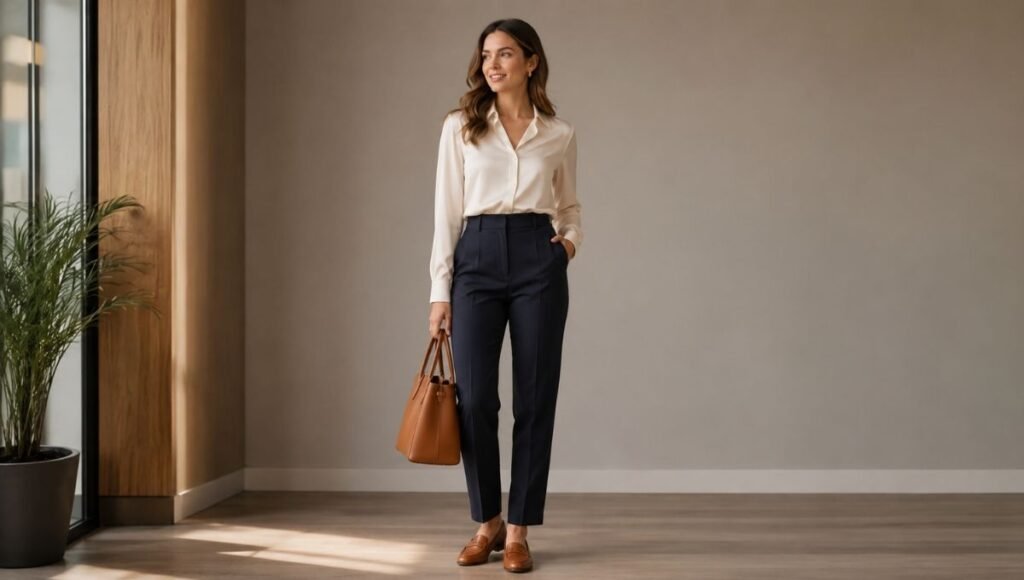
You got the job offer. Or the interview. Or the invitation to a networking event. And somewhere in the details, it says “business casual attire.” You nod, close the email, and then immediately open Google because — if you’re honest — you’re not entirely sure what that means for you specifically. Not in theory. In practice. For your body, your industry, your actual wardrobe.
You’re not alone in this. What is business casual for women is one of the most Googled workplace questions for a reason: the phrase is genuinely ambiguous. A Gallup poll found that 51% of women in the U.S. wear business casual to work most days — making it the dominant dress code of modern office life — and yet there’s no universal definition. Business casual at a law firm looks nothing like business casual at a tech startup. Business casual for a client presentation looks nothing like business casual for a Tuesday at your desk. And the advice most guides give (“tailored trousers and a blouse!”) isn’t wrong — it’s just incomplete.
This guide gives you the complete version. What business casual actually means, how it differs from smart casual, what the dress code looks like by industry, the specific outfit formulas that work, which shoes are appropriate and which aren’t, and how to make any of this work for your body type.
Key Takeaways
- Business casual is not one thing — it sits on a spectrum from “one step below a full suit” in conservative corporate environments to “intentional and polished but not formal” in creative or tech offices. Reading your specific workplace matters more than following a generic list
- According to a 2024 Gallup workplace survey, 51% of American women now wear business casual to work most days — it is the default dress code across most modern industries
- The one-rule definition that works across all industries: business casual is any outfit where every piece is clean, fits well, has no visible wear, and could not be confused for what you’d wear running weekend errands. Everything within that boundary is negotiable
- Business casual shoes for women are widely misunderstood — loafers, leather flats, block-heel sandals, and clean leather sneakers (in some offices) all qualify. The issue is condition and intentionality, not category
- Smart casual vs business casual are different things: smart casual dresses up from everyday wear; business casual dresses down from formal wear. Same destination sometimes, very different starting points
What Is Business Casual for Women? The Actual Definition
Business casual emerged in the 1990s when companies began relaxing the suit requirement, and the phrase has been creating confusion ever since. The reason it’s confusing is structural: it’s a relative term, not an absolute one.
The most useful definition isn’t a list of specific pieces — it’s a principle:
Business casual is a level of dress that reads as professional and intentional without requiring formal suiting.
Everything that falls within that principle — tailored trousers, structured blouses, midi dresses, blazers, polished flats, loafers, block heels — is business casual. Everything that reads as “I dressed for the weekend” (athleisure, graphic tees, distressed denim, flip flops) or “I dressed for a black-tie event” falls outside it.
The Business Casual Spectrum
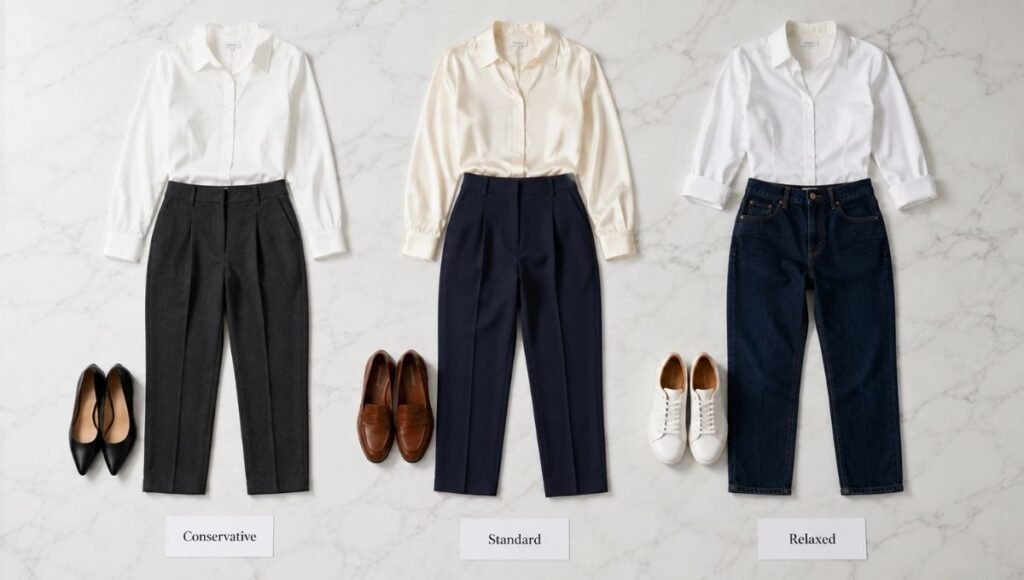
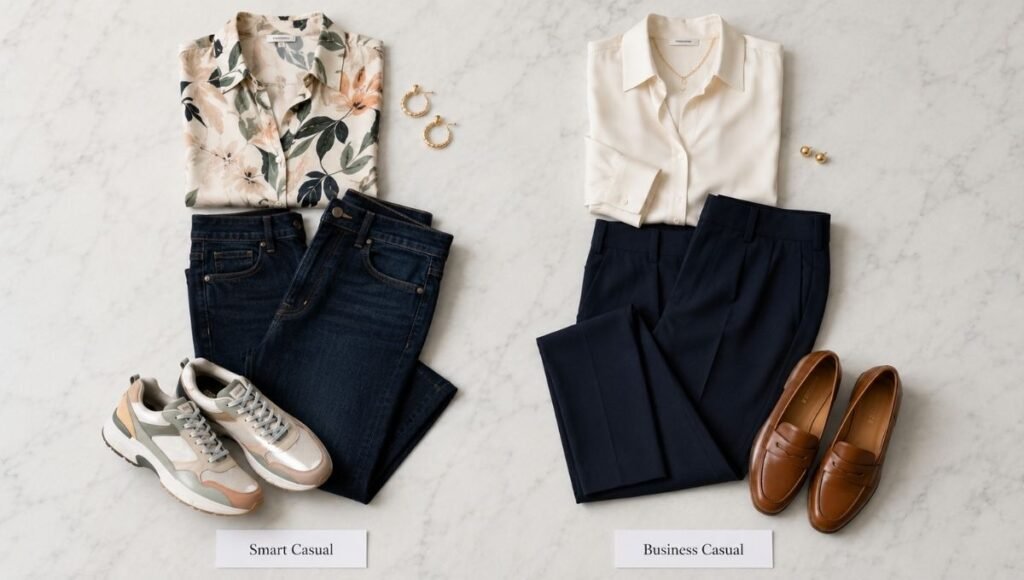
The phrase covers a wide range. At the more formal end: a structured blazer with tailored trousers and pointed-toe flats. At the more relaxed end: dark-wash jeans with a silk blouse and leather loafers. Both are business casual — but they belong to different points on the spectrum, and the right point depends on your specific workplace.
Conservative business casual (law firms, finance, consulting): Tailored trousers or a structured midi skirt, a fitted blouse, a blazer, closed-toe shoes. This is business casual at its most formal — one step below a full suit.
Standard business casual (mid-size companies, corporate teams): A wider range. Tailored trousers or dark-wash jeans, blouses or fitted knits, dresses at or below the knee, flats or low heels or loafers.
Relaxed business casual (startups, tech, creative agencies): Dark-wash jeans or chinos, fitted tops, clean sneakers or loafers. The “business” element is in the fit and intentionality, not in the formality of the specific pieces.
Business Casual vs Smart Casual: What’s Actually the Difference?
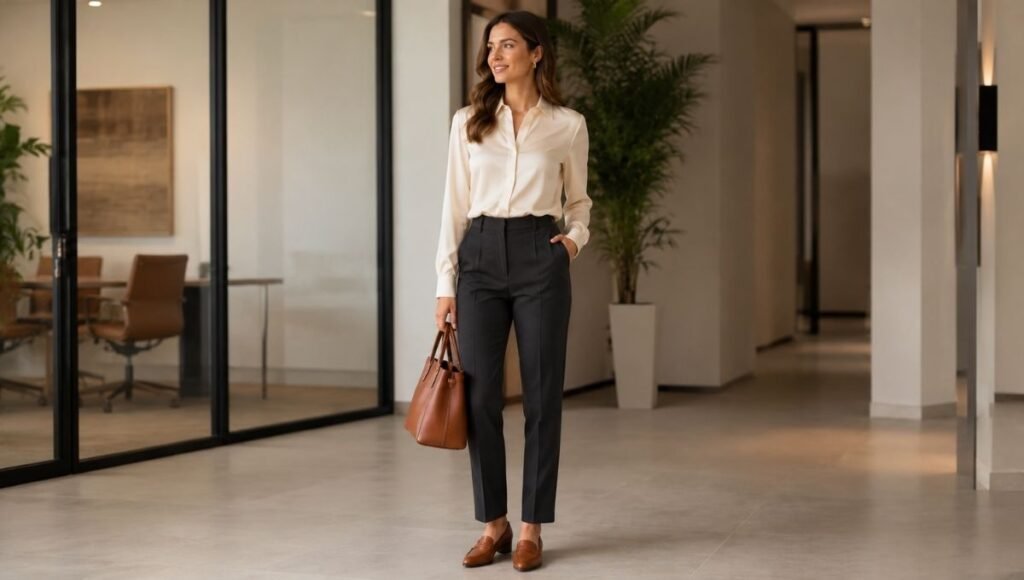
These two dress codes are constantly confused — and the confusion has real consequences. Here’s the distinction that actually matters:
Business casual starts from business professional (formal suiting) and dresses down. The baseline is professional.
Smart casual starts from everyday casual wear and dresses up. The baseline is relaxed.
The result can sometimes look similar — a woman in dark jeans, a blouse, and loafers could be either. But the mental model is different, and it matters for knowing where the limits are.
Smart casual allows: Clean sneakers, fashion-forward pieces, trendy silhouettes, casual fabrics worn intentionally.
Business casual requires: A baseline of professionalism even at its most relaxed end.
The Dress Code Hierarchy
Business Formal → Full suit or gown required
Business Professional → Suit or structured suit-like separates
Business Casual → Professional but not formal — this guide
Smart Casual → Elevated everyday, more fashion-forward
Casual → No dress code; genuine everyday wear
Business Casual by Industry: Context Is Everything
The most important thing missing from most business casual guides: the definition varies dramatically by industry. Here’s what it actually looks like across common workplaces.
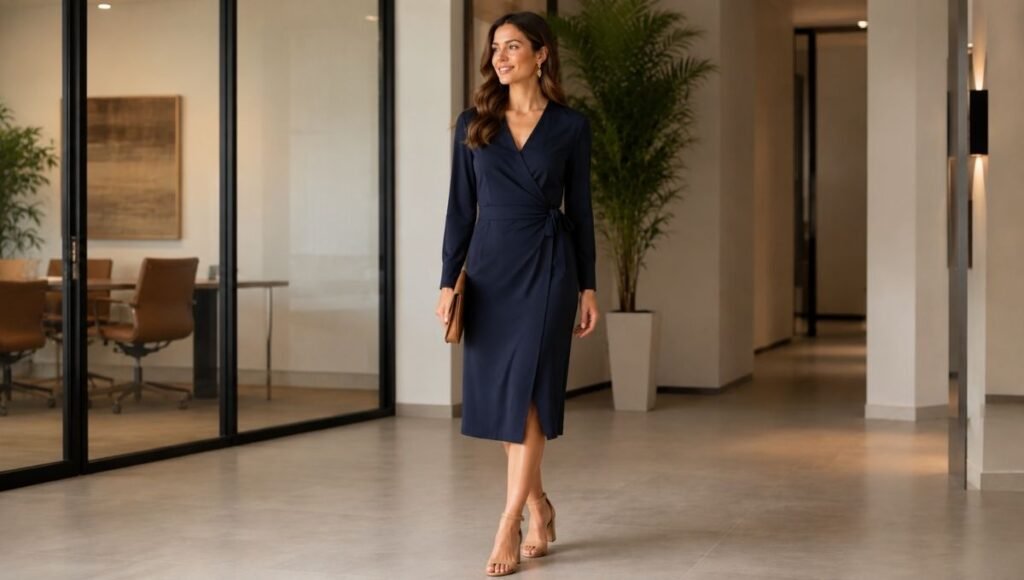
Finance, Law, Consulting, Banking
Business casual at its most conservative. The baseline is professional suiting; business casual means relaxing from that without losing the professional signal.
What works: Tailored trousers in black, navy, or charcoal + a structured silk or silk-feel blouse (tucked) + a blazer (optional but common) + closed-toe flats, loafers, or low block heels. Sheath dresses or structured wrap dresses in solid colors. A structured midi skirt with a fitted blouse.
What to avoid: Dark jeans (even in some of these environments), visible logos, overly trendy silhouettes, open-toe shoes, bold patterns.
Editor’s note: In conservative corporate environments, being slightly more formal than you think you need to be is almost always the safer call — at least until you understand your specific team’s culture.
Tech, Startups, Creative Agencies
Business casual at its most relaxed. The “business” element is less about specific pieces and more about intentionality — looking like you made a deliberate choice, not like you grabbed whatever was closest.
What works: Dark-wash jeans (no distressing, good fit) + a fitted blouse or elevated tee + a blazer or structured cardigan + clean leather or leather-look sneakers, loafers, or ankle boots. A casual midi dress with a denim jacket. Chinos with a tucked fitted shirt.
What to avoid: Athletic wear, graphic tees with loud imagery, anything visibly worn or faded, flip flops.
Healthcare, Education, Corporate Retail
A practical middle ground — professional enough for client or patient interaction, comfortable enough for an active role.
What works: Comfortable tailored trousers or ponte pants + a structured blouse or fitted cardigan + clean closed-toe shoes. Midi dresses or wrap dresses that allow full movement. Dark-wash jeans with a polished top in less formal settings.
Business Casual Outfit Formulas: What to Actually Wear
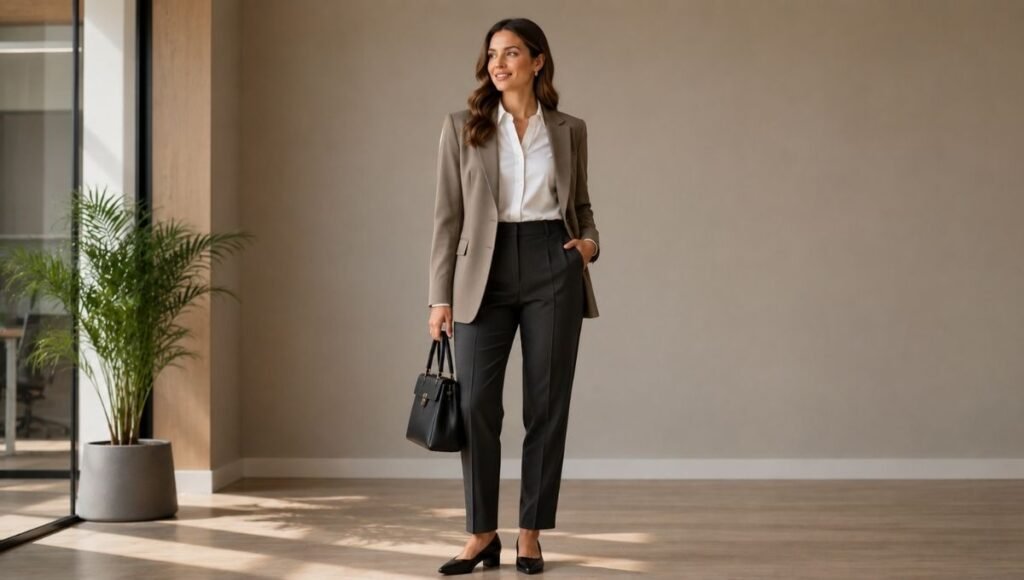
Formula 1: The Classic
High-waist tailored trousers + structured blouse (tucked) + loafers or pointed-toe flats
The universal business casual formula that works across every industry. The trouser and blouse create the professional baseline; the loafer finishes cleanly. Add a blazer when you need to elevate — for a client meeting, an interview, a presentation.
Formula 2: The Dress
Structured midi dress (wrap, sheath, or A-line) + block-heel sandals or flats + simple jewelry
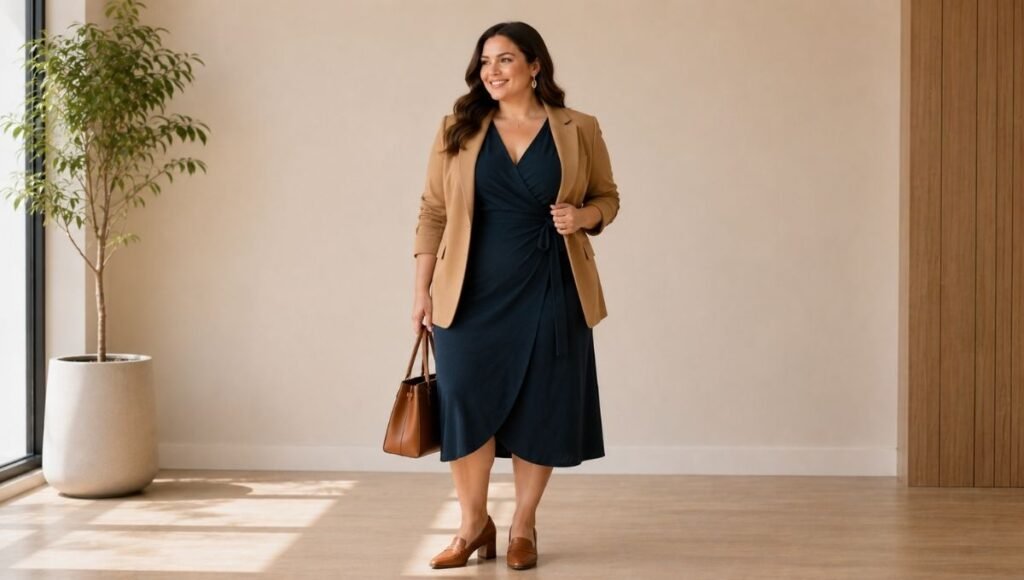
The most underrated business casual formula. One piece, no coordination required, already a complete professional look. Wrap dresses work on every body type; sheath dresses have the most formal read; A-line midi dresses are the most relaxed while still reading as professional.
The hemline rule: The dress should hit at or below the knee in any conservative setting. A dress that hits above mid-thigh reads as either too casual or too dressed-up-for-a-different-occasion in most offices.
Formula 3: Relaxed Business Casual
Dark-wash straight-leg jeans + silk or satin-feel blouse (tucked) + leather loafers + structured bag
For tech, creative, and startup environments where the dress code is genuinely relaxed. The jeans signal approachability; the silk blouse elevates; the loafer finishes professionally.
The jeans rule: Dark wash, good condition, good fit. Dark-wash stretch denim that fits well reads more professionally than light-wash structured denim. No distressing, no visible wear, no rips.
Formula 4: Casual Friday
Chinos or dark jeans + fitted crewneck or clean tee (tucked) + clean sneakers or loafers
For offices that genuinely observe casual Fridays. The casual element is the top; the structure comes from trouser fit and the fact that everything is clean and intentional.
Business Casual Shoes for Women: The Complete Guide
This is the category where most guides give the vaguest answers. Here’s the actual breakdown.

Shoes That Work
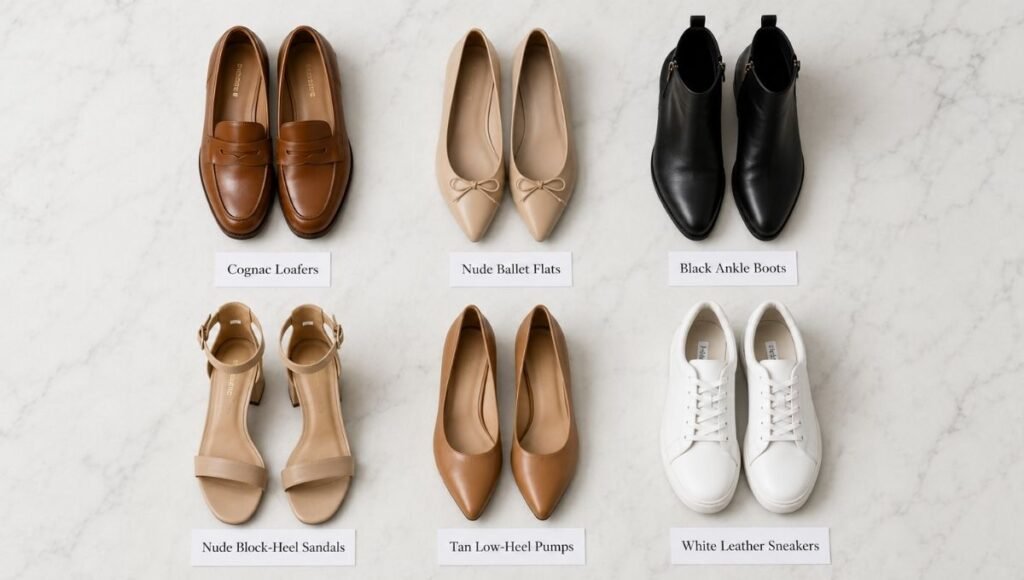
Loafers: The single most versatile business casual shoe. Leather or leather-look in black, tan, or cognac works from conservative corporate to creative startup. Penny loafers, horsebit loafers, and platform loafers all qualify.
Ballet flats: Classic, professional, comfortable. Pointed-toe versions are more polished than round-toe. Leather or leather-look materials are more professional than fabric or canvas.
Block-heel sandals: Appropriate in most business casual environments during warm months. The block heel reads as stable and professional in a way a very strappy stiletto sandal doesn’t. Avoid heavily embellished styles in conservative settings.
Low-to-mid heeled pumps: The traditional choice. Block heels at 1.5–3 inches are more appropriate and more comfortable than very high stilettos. Pointed or almond toe in neutral colors (nude, black, navy) works universally.
Ankle boots: Particularly in fall and winter. A clean leather ankle boot with a low or medium heel reads as polished in most business casual settings.
Clean leather sneakers: In relaxed business casual environments (tech, creative) only. The leather detail is what allows a sneaker to cross into business casual territory — canvas trainers or athletic shoes don’t make this transition.
Shoes That Don’t Work
- Flip flops or pool slides
- Very strappy, heavily embellished evening sandals
- Visibly worn or scuffed shoes of any kind
- Athletic trainers or running shoes
- Very casual canvas sneakers in conservative settings
- Boots with aggressive platform soles or heavy hardware
The principle: The shoe should look like it was chosen for the occasion. Condition matters as much as style — polished loafers with visible wear read as less professional than a simple clean flat.
Business Casual by Body Type
For Petite Women
The main challenge: hemlines and proportions. A midi skirt that hits just below the knee on a 5’5″ woman hits at an unflattering mid-calf on a 5’2″ woman.
The petite business casual formula: High-waist dark tailored trousers + a fitted blouse (fully tucked) + a blazer ending at the natural waist (not hip-length) + pointed-toe shoes. The high waist and pointed toe work together to create maximum visual leg length.
For dresses: A dress hitting just above or at the knee often reads more professionally on a petite frame than a true midi. If you love midi dresses, wear with a heel that keeps the hem at the right position and consider hemming for your specific heel height.
For Curvy Women
Fit first, structured fabrics, waist definition — the three non-negotiables.
The curvy business casual formula: High-waist wide-leg or straight-leg tailored trousers + a V-neck fitted blouse (tucked) + a structured blazer worn open (let it frame, not constrain) + block-heel loafers or pumps.
For dresses: Wrap dresses and sheath dresses with some stretch are the most reliably flattering options. Wrap creates waist definition through construction; a stretch sheath moves with the body rather than creating pressure points.
The fabric note: Fabrics with a small amount of stretch (stretch crepe, jersey, ponte with elastane) look significantly more polished on curvy frames than very rigid, stiff fabrics that create pressure points.
What Not to Wear to a Business Casual Office
The less-obvious things that regularly cross the line:
Leggings as trousers — even black ones, even with a long tunic. They read as casual regardless of context in most offices.
Sheer tops without a camisole layer — a sheer blouse over a camisole is business casual. Sheer with nothing underneath is not.
Visible wear on any piece — pilling, fading, fraying, missing buttons all undermine otherwise appropriate pieces. Condition is as important as category.
Very loud logos or graphics — a subtle brand logo is different from a graphic statement tee. The latter reads as casual regardless of pairing.
Very casual shoes in conservative environments — even with an otherwise appropriate outfit, the wrong shoe undermines the overall impression.
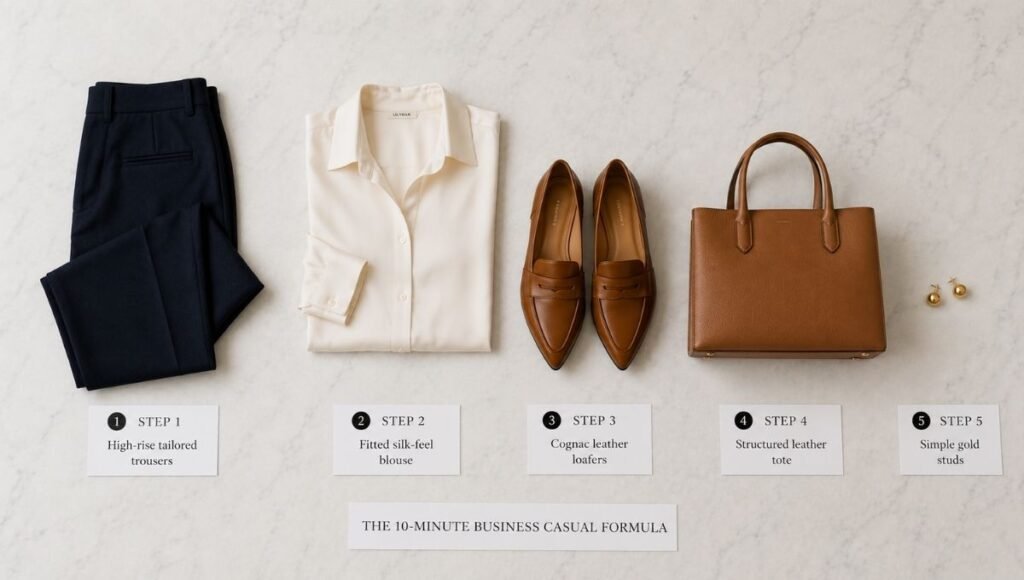
The 10-Minute Business Casual Formula
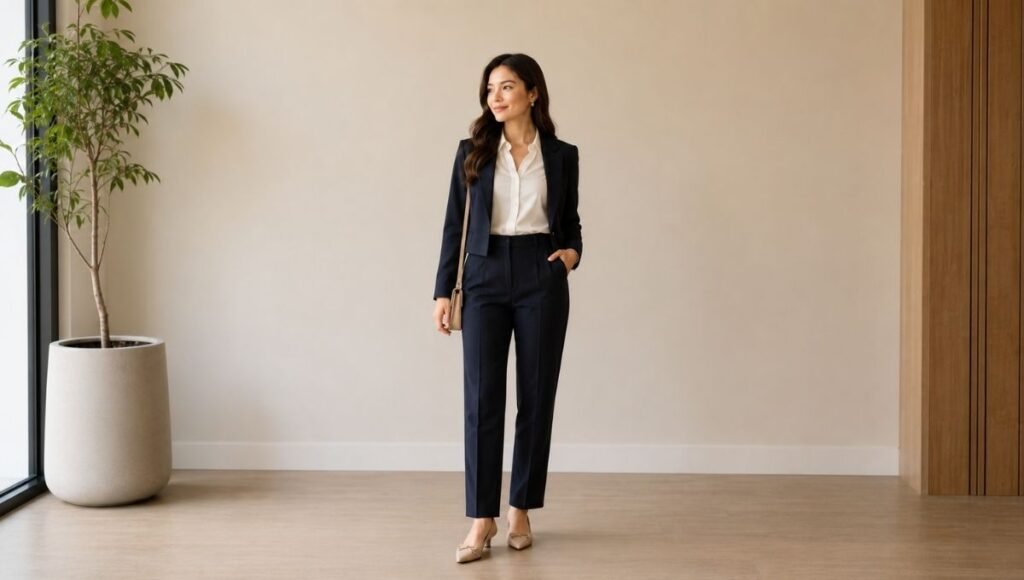
Running late, need to be dressed in ten minutes:
Step 1: High-waist dark trousers or a structured midi dress. Step 2: A silk-feel blouse or fitted structured top (tucked). Step 3: Loafers, block-heel flats, or clean leather shoes. Step 4: A structured bag. Step 5: Simple gold or silver studs.
Done. This formula works across conservative and relaxed business casual environments alike — the specific pieces adjust, but the structure is the same every time.
FAQ: Business Casual for Women
What is business casual for women exactly? Business casual is a dress code that sits between business formal (full suiting) and everyday casual. It requires a professional, polished appearance without requiring a suit. Key pieces include tailored trousers or skirts, structured blouses or tops, midi or knee-length dresses, blazers, and professional footwear. The specific interpretation varies significantly by industry and company culture.
What is the difference between business casual and smart casual for women? Business casual starts from formal professional wear and dresses down — the baseline is professional. Smart casual starts from everyday casual and dresses up — the baseline is relaxed. Both can look similar at their meeting point, but business casual requires a more consistent professional appearance, while smart casual allows more fashion-forward choices.
Can you wear jeans for business casual? It depends on the industry and company. In conservative environments (finance, law, consulting), jeans are generally not business casual. In tech, creative, and startup environments, dark-wash jeans without distressing in a good fit often qualify. When uncertain, observe what senior colleagues wear or ask during hiring.
What are business casual shoes for women? Loafers, leather ballet flats, block-heel sandals, low-to-mid heeled pumps, ankle boots, and clean leather sneakers (in relaxed environments). What doesn’t qualify: flip flops, very strappy evening sandals, athletic trainers, visibly worn shoes of any kind. Condition matters as much as category.
Is a blazer required for business casual? No — a blazer is an option, not a requirement. It instantly elevates any business casual outfit and is useful for interviews, client meetings, or formal days. But a polished blouse with tailored trousers, or a structured midi dress, reads as business casual without one in most environments.
What should you not wear to a business casual office? Leggings as trousers, sheer tops without a layer, athletic wear, very short hemlines, loud graphic prints or visible logos, very casual footwear, and anything with visible wear (pilling, fading, fraying).
What to Read Next
- Work Outfits for Women: What to Wear to the Office — the companion outfit guide with specific looks by industry and season
- Interview Outfits for Women: What to Wear — when business casual needs to lean more formal for a first impression
- Outfit Ideas for Women: What to Wear for Every Occasion — the complete occasion guide beyond the office
- How to Dress for Your Body Type: The Complete Style Guide — body type principles that apply to professional dressing
Sophie Hartwell covers practical occasion-specific style advice for women who want outfits that actually work at TopChicWear.
References:
- Gallup. (2024). State of the American Workplace: Dress Code and Attire Trends. Gallup Inc.
- Slepian, M. L., Ferber, S. N., Gold, J. M., & Rutchick, A. M. (2015). The cognitive consequences of formal clothing. Social Psychological and Personality Science, 6(6), 661–668.
- Peluchette, J., & Karl, K. (2007). The impact of workplace attire on employee self-perceptions. Human Resource Development Quarterly, 18(3), 345–360.
Disclosure: This post may contain affiliate links. We may earn a small commission if you purchase through our links at no extra cost to you. All recommendations are genuinely our own.