
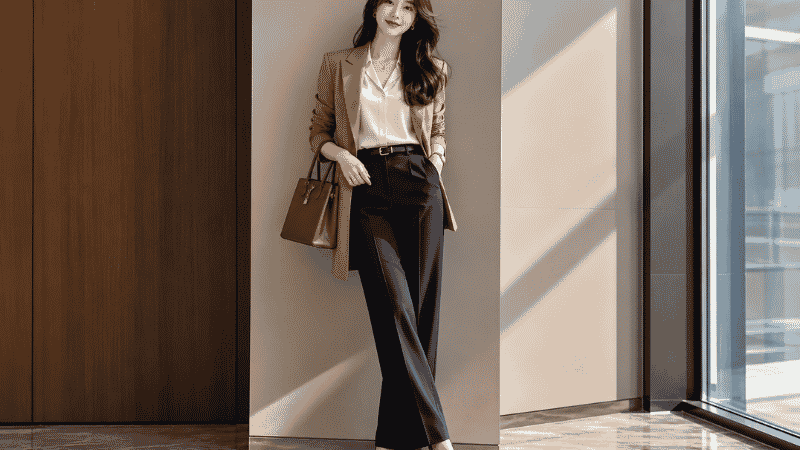
Monday morning. You’re standing in front of your closet with twenty minutes to spare and absolutely no idea what to wear. Your company’s dress code says “business casual” — a phrase that means something completely different depending on who you ask, what industry you’re in, and what decade they last updated the employee handbook.
This is the real problem with work outfits for women: the rules are genuinely unclear, and most style guides make it worse by giving you generic advice that doesn’t account for where you actually work, what your body actually looks like, or what budget you’re actually working with.
This guide fixes that. We’re going to define business casual properly — including the fact that it’s not one thing but a spectrum — break down what it means by industry, give you specific outfit formulas by body type, and cover the teacher outfit ideas question specifically, because classroom dressing has its own set of practical requirements that regular office guides completely ignore. By the end, you’ll know exactly what to put on tomorrow morning.
Key Takeaways
- Business casual is not one dress code — it ranges from “smart casual” (neat jeans acceptable) to “elevated business casual” (tailored trousers required), and your industry determines where you fall
- A 2023 SHRM workplace survey found that dress code clarity directly correlates with employee confidence — workers who understood their company’s dress expectations reported 27% higher comfort levels on their first weeks
- The single most useful business casual formula for women: one tailored piece + one relaxed piece + one grounding shoe — this combination works across almost every office environment
- Teacher outfit ideas follow different rules than corporate dressing — comfort, movement range, and washability matter more than they do in a desk job
- For petite women: high-waist trousers and midi skirts that hit just below the knee are the two most reliable work outfit foundations — both create vertical length without sacrificing professionalism
- For curvy women: structured blazers and wrap dresses are the two most consistently flattering and office-appropriate silhouettes
What Is Business Casual for Women? The Honest Definition
Let’s settle this once and for all, because “business casual” has caused more wardrobe stress than almost any other two-word phrase in fashion history.
Business casual sits between business formal (suits, structured dresses, full professional attire) and casual (jeans, t-shirts, weekend clothes). But here’s what most guides don’t tell you: business casual is a spectrum, not a fixed point. And where your workplace falls on that spectrum depends almost entirely on your industry.
The practical definition: business casual means looking polished and professional without looking like you’re going to court. It means clothing that’s intentional, clean, well-fitting, and appropriate for a professional environment — but doesn’t require a suit.
What it includes: tailored trousers, blouses, knit tops, blazers, midi skirts, wrap dresses, smart casual dresses, loafers, heeled sandals, ankle boots, ballet flats.
What it excludes: athletic wear, graphic tees, very short hemlines, overly casual denim (distressed, very light wash), flip flops, anything with visible logos as a focal point.
That’s the baseline. Now let’s talk about how it actually differs by industry — because this is where most women go wrong.
Business Casual by Industry: What It Actually Means Where You Work
Corporate and Finance: The Stricter End of the Spectrum
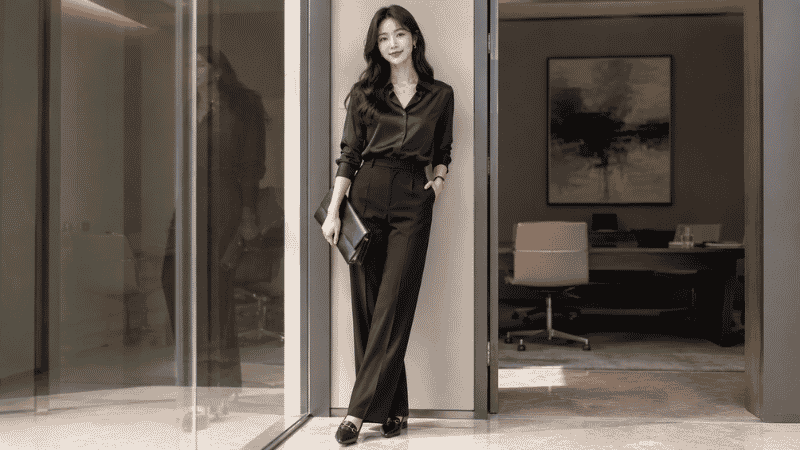
Investment banking, law, consulting, corporate HR, and traditional finance environments sit at the more formal end of business casual. Here, “casual” is relative — you’re still expected to look very polished, and the line between business casual and business formal is thin.
What works here:
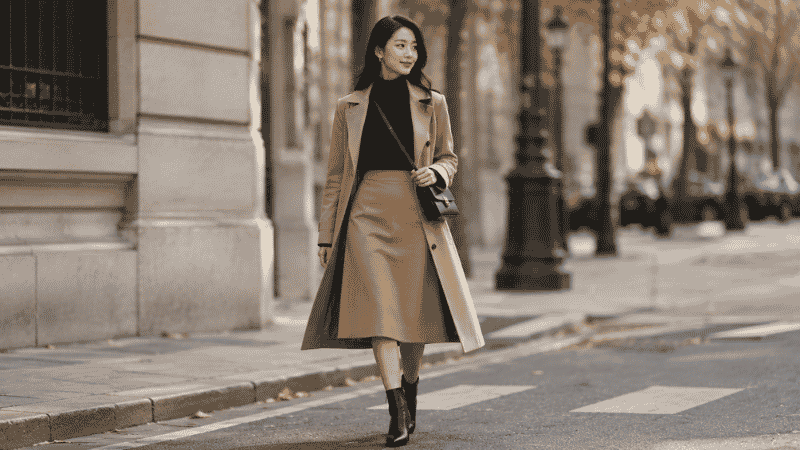
- Tailored trousers in navy, black, charcoal, or camel + a silk or structured blouse
- A pencil skirt or A-line midi skirt at or below the knee + a fitted blazer
- A sheath dress or wrap dress in a solid color or subtle pattern
- Heeled shoes (block heel or kitten heel) or clean leather loafers
- Structured bags — a leather tote or structured shoulder bag
What to avoid: Jeans of any wash, visible casualwear elements, anything sleeveless without a layer over it, very open-toe sandals, athleisure-adjacent fabrics like ponte that reads as casual in this context.
The formula: Tailored trouser + silk or structured blouse + blazer when needed + leather loafer or block heel. This formula works five days a week in a corporate environment and requires minimal thinking once you have the pieces.
Creative Industries: The Relaxed End of Business Casual
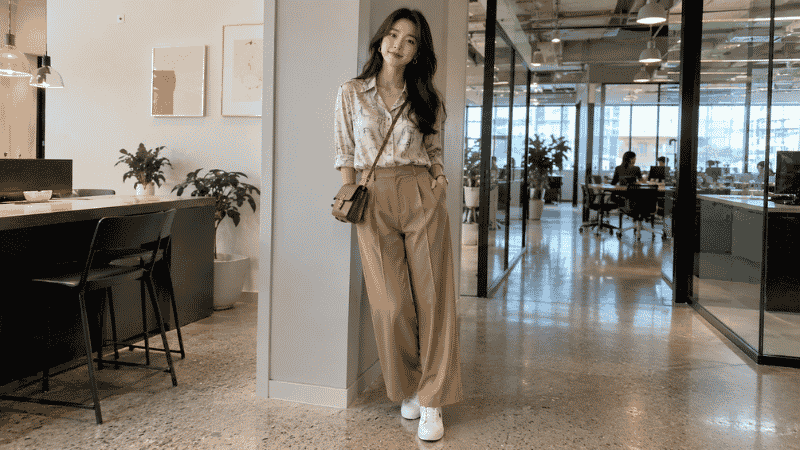
Marketing agencies, design studios, tech companies, media, and creative environments have a much more relaxed interpretation of business casual. Here, personal style is more visible and expected — and wearing a full suit might actually make you look out of touch.
What works here:
- Dark-wash or black straight-leg jeans + a fitted blouse or structured top + clean sneakers or loafers
- Wide-leg trousers in a fun color or print + a simple fitted top
- A casual dress or co-ord set that reads as intentional rather than formal
- Ankle boots, chunky loafers, clean white sneakers
The creative office formula: One piece with a bit of personality (a print, a color, an interesting texture) + everything else clean and simple. The personality piece is what signals you understand creative culture without underdressing.
Healthcare and Education: Practical Business Casual
If you work in a school, hospital, clinic, or social services environment, “business casual” has a third dimension that desk-job guides never mention: practical durability. You’re on your feet, you might be crouching, kneeling, or moving around constantly, and your clothes need to survive a full day of physical activity.
We’ll cover teacher outfits in detail below — but the general principle is: professional-looking fabrics that move and wash well, comfortable footwear that looks intentional, and nothing that requires constant adjustment.
Teacher Outfit Ideas: What to Wear When You’re on Your Feet All Day
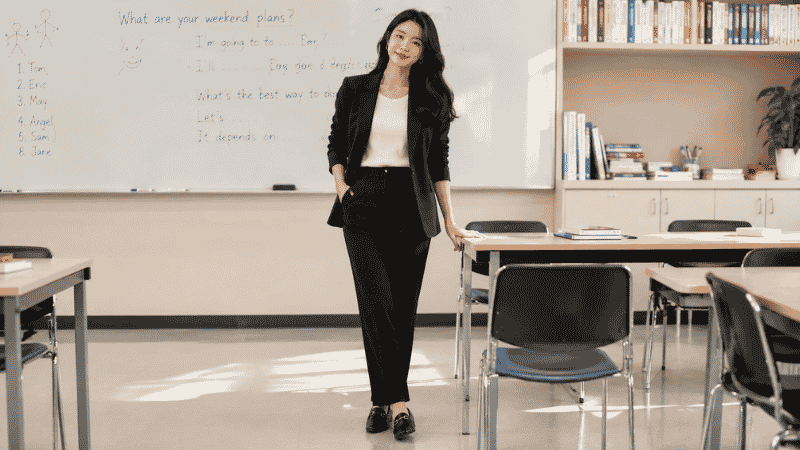
Teaching has a dress code that no office guide adequately covers, so let’s give it the section it deserves.
The challenge of teacher dressing is fourfold: you need to look professional enough to command a classroom, comfortable enough to be on your feet for six or seven hours, practical enough to survive a day that might involve anything from art projects to recess supervision, and budget-conscious enough that you can build a real wardrobe on a teacher’s salary.
The teacher outfit foundations:
High-waist wide-leg or straight-leg trousers in a stretch fabric. This is the single most important piece in a teacher’s wardrobe. A trouser in a ponte or stretch crepe fabric looks polished and professional but has the flexibility and comfort of casual pants. You can sit on the floor, crouch down to a student’s level, and be on your feet all day without any of the discomfort that stiff tailored trousers would cause. Buy multiple pairs in neutral colors — black, navy, camel — and rotate them throughout the week.
Fitted knit tops and simple blouses. A simple ribbed crewneck top or a soft fitted blouse in a solid color is the most reliable teacher top. It’s professional-looking, comfortable, easy to layer, and machine-washable — which matters enormously when you’re in a classroom. Avoid dry-clean-only fabrics for daily teaching wear.
A blazer or cardigan as a layer. Teachers often move between air-conditioned classrooms and outdoor supervision. A light cardigan or an open blazer gives you the layer you need without bulk. It also instantly elevates any outfit underneath from casual to professional when parents or administrators appear.
Comfortable professional footwear. This is non-negotiable. A teacher in uncomfortable shoes is a teacher who is miserable by 2pm. The best options: leather loafers with a cushioned insole, block-heeled ankle boots (comfortable and polished), supportive flats with a structured sole. Avoid stilettos entirely — the combination of hard classroom floors and hours of standing makes them genuinely painful and impractical.
Specific teacher outfit formulas:
- Black stretch trousers + fitted cream or white knit top (tucked) + cardigan + leather loafers
- Navy straight-leg ponte trousers + a soft floral or printed blouse + simple flats
- A fit-and-flare midi dress in a solid color or subtle print + a cardigan layer + flat sandals or loafers (for warmer months)
- Dark-wash straight-leg jeans (if your school allows denim) + a structured blouse + blazer + ankle boots
The washability rule: If you teach younger children especially, ask yourself before buying anything: “Can I wash this at home if it gets marker/paint/lunch on it?” If the answer is no, it’s not a practical teaching outfit, regardless of how good it looks.
Professional Outfits for Women by Body Type
For Petite Women: The Proportional Office Formula
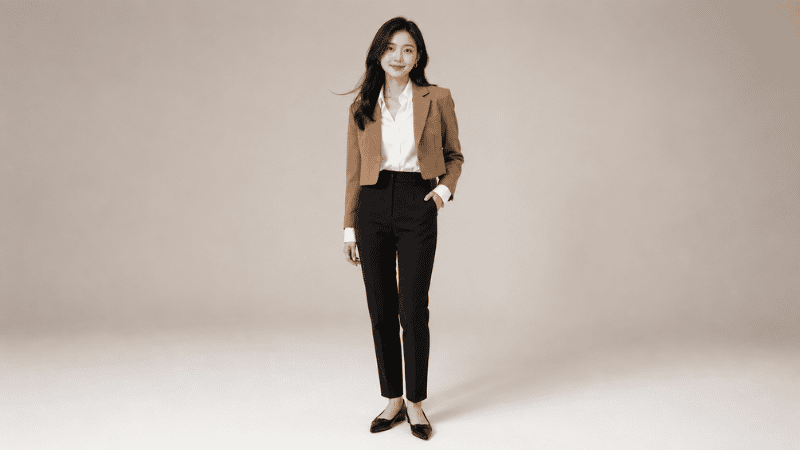
The challenge for petite women in professional settings is that most workwear — especially tailored pieces — is cut for taller frames. A blazer that hits at the hip on a 5’7″ woman hits at the thigh on a 5’2″ woman, which throws off the proportion completely.
What works for petite professional dressing:
- High-waist trousers with a full tuck. The high waist creates the visual impression of longer legs. Always tuck your top completely or use a French tuck — never leave a top untucked over high-waist trousers, as it hides the waistline and shortens the silhouette.
- Midi skirts that hit just below the knee — not mid-calf. A midi skirt at mid-calf on a petite frame cuts the leg at its narrowest point and makes you look shorter. Just-below-the-knee is the sweet spot.
- Cropped or fitted blazers rather than long blazers. A blazer that ends at the natural waist rather than the hip creates a much more proportional silhouette on a petite frame.
- Monochromatic outfit combinations — wearing the same color family from top to bottom creates an unbroken vertical line that adds perceived height. Black trousers + black top, or camel trousers + cream top, both work.
- Pointed-toe shoes always — whether flats, loafers, or heels. The pointed toe creates a visual line that extends the leg length in a way round-toe shoes simply don’t.
What to approach carefully: Oversized blazers (they overwhelm petite frames unless deliberately styled), very wide-leg trousers with flat shoes (you need at least a small heel to balance the volume), and horizontal details across the hip that cut the body in half visually.
For Curvy Women: The Structured Flattery Formula
Professional dressing for curvy bodies is actually one of the more straightforward body type styling challenges — because structured, tailored pieces (which workwear inherently skews toward) are inherently more flattering on curvy frames than on straight ones.
What works best for curvy professional dressing:
- A structured blazer is genuinely one of the most flattering pieces a curvy woman can own. It creates a defined shoulder line, allows draping over the bust and hip without clinging, and projects authority. An open blazer over a simple fitted top and trousers is a complete, polished, flattering work outfit.
- Wrap dress or wrap-bodice styles — the V-neckline creates vertical length through the torso, the wrap ties at the natural waist rather than assuming where your waist is, and the silhouette creates definition regardless of your specific proportions. In a work-appropriate fabric and length (knee to midi), the wrap dress is one of the most reliable curvy work outfits there is.
- High-waist wide-leg trousers + tucked fitted top — same principle as brunch and date night, but in work-appropriate fabrics (ponte, stretch crepe, wool blend). The wide leg moves with you throughout a full workday, the high waist creates definition, the fitted top balances the volume below.
- Ruched or seamed fabric over plain — clothing with subtle seaming and ruching creates shape through construction rather than cling, which is consistently more flattering and more comfortable over a full workday.
Fabric note for curvy work dressing: Avoid very stiff or rigid fabrics (some thick twill, rigid canvas) in fitted silhouettes — they don’t move with the body and can create pulling and bunching. Opt for ponte, stretch crepe, jersey, or woven fabrics with some give.
Business Casual Dress Women: When a Dress Is the Whole Outfit
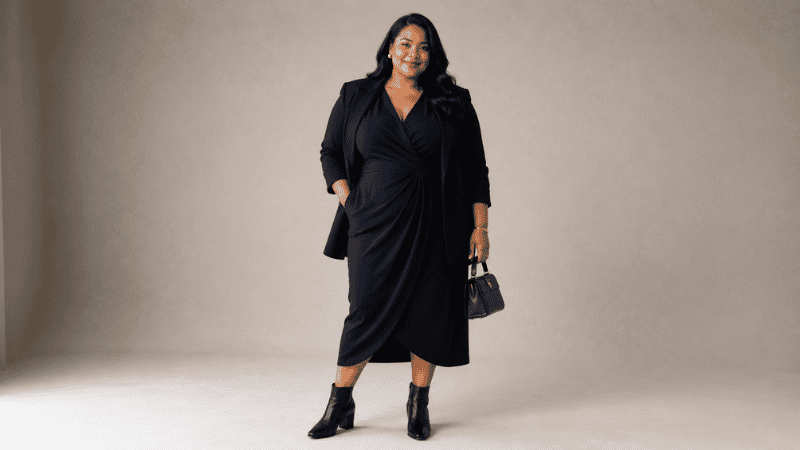
One of the most underused work outfit solutions is the single-piece dress — specifically because it removes the decision about what goes with what. One good work dress is a complete outfit.
The dresses that work across most office environments:
The wrap dress. Works in almost every business casual environment. The V-neck is universally flattering, the silhouette is professional without being stiff, and it comes in enough fabric options (from jersey for casual offices to matte crepe for more formal ones) to suit most workplaces. Keep the hem at the knee or below for office appropriateness.
The sheath dress. The most formal of the business casual dress options. A sheath in a solid color with a blazer over the top is boardroom-appropriate in most environments. It’s also one of the most efficient morning outfits — dress on, blazer on, shoes on, done.
The knit midi dress. A ribbed or structured knit midi dress bridges the gap between casual and professional beautifully. It’s comfortable enough for a full day, looks polished enough for client-facing roles, and works in both corporate-casual and creative environments depending on how you accessorize it.
What to look for in a work dress: Knee-length or longer hem, a neckline that’s covered when sitting and leaning forward, no fabric that becomes sheer in sunlight, a silhouette that allows comfortable movement in a chair for extended periods.
The 10-Minute Work Outfit (For the Mornings That Go Wrong)
It’s 7:50am. You have ten minutes before you need to leave. Here is the formula:
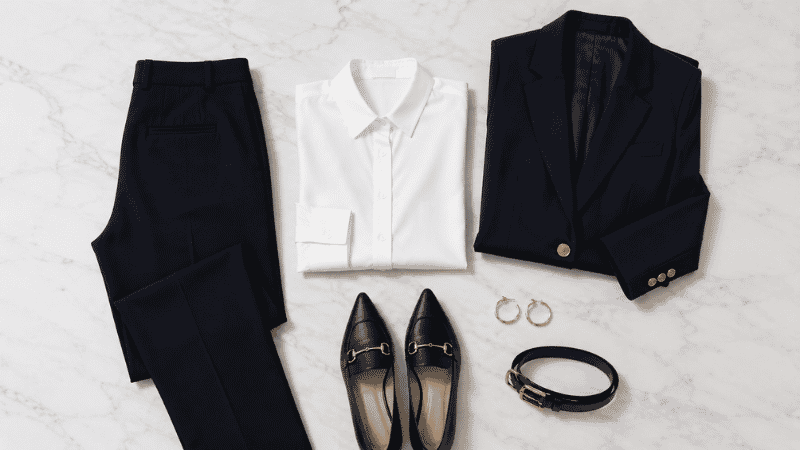
Step 1: Your best-fitting work trousers. Black or navy — the colors that go with everything.
Step 2: A fitted top in a solid color. A simple ribbed crewneck, a clean blouse, a fitted turtleneck. Tuck it in fully.
Step 3: A blazer if you have a meeting, a cardigan if you don’t. Thrown on top. It makes the whole thing look intentional.
Step 4: Loafers or clean ankle boots. Not sandals unless it’s summer and your office is genuinely casual.
Step 5: One piece of jewelry. A simple necklace or gold hoops. Not both.
Total: under ten minutes. You’ll look put-together. This is the formula to memorize.
Work Outfit Mistakes That Make You Look Less Polished
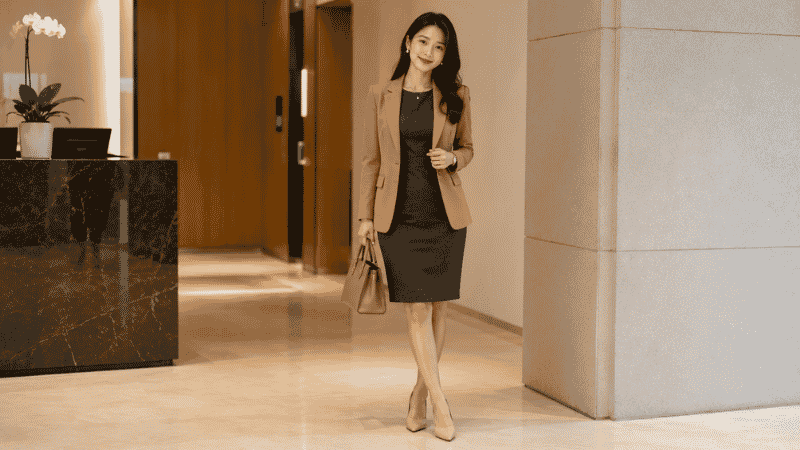
Wearing clothes that don’t fit properly. This is the number one work outfit mistake. A $30 blouse that fits perfectly looks more professional than a $200 blouse that pulls across the shoulders or gaps at the buttons. Fit always matters more than price.
Ignoring the hemline rule. For professional environments, skirts and dresses should be at or below the knee when you’re standing — and should stay at or below the knee when you sit down. Test this before you wear something to the office.
Wearing shoes you can’t walk in confidently. Awkward walking undermines the professionalism of any outfit. Wear heels you can actually move in, or choose a flat or low heel you’re comfortable with.
Underdressing for meetings. Even in casual offices, important meetings (client presentations, interviews, performance reviews) call for a slightly more elevated look than your everyday work outfit. Keep a blazer at your desk for exactly this purpose.
Clothes that need constant adjustment. A neckline that keeps slipping, a skirt that rides up, a top that comes untucked — these things are distracting in a professional setting. If you spent the morning adjusting it at home, don’t wear it to the office.
FAQ: Work Outfit Questions Answered
What is business casual for women? Business casual for women means polished, professional clothing that’s less formal than a suit. Think tailored trousers, blouses, blazers, midi skirts, wrap dresses, and smart footwear. It excludes athletic wear, very casual denim, graphic tees, and anything that would be more at home on a weekend than in a workplace.
What should I wear to work on my first day? Slightly overdressed rather than underdressed. A tailored trouser or midi skirt with a blouse and a blazer covers almost every office environment — you can adjust down once you see the actual culture. First-day dressing errs conservative.
Are jeans business casual for women? In some offices yes, in others no. Dark-wash, well-fitting, unripped jeans with a blouse and a blazer can read as business casual in creative and tech environments. In finance, law, or traditional corporate settings, jeans are typically not business casual. When in doubt, save jeans for casual Fridays or ask your manager.
What should curvy women wear to work? Wrap dresses, structured blazers over fitted tops and wide-leg trousers, and A-line or fit-and-flare skirt styles. Look for work pieces in fabrics with some stretch (ponte, stretch crepe) that move comfortably through a full workday without restricting or clinging.
What are good teacher outfit ideas? Stretch ponte trousers + a simple knit top + a cardigan or blazer + leather loafers. A fit-and-flare midi dress + flat sandals or loafers in warmer months. The priorities for teacher dressing are: machine-washable fabric, comfortable footwear, professional appearance, and enough flexibility of movement for a day that involves everything from board work to floor-level activities.
What shoes are appropriate for a business casual office? Loafers, block-heel sandals, ankle boots, kitten heels, pointed-toe flats, clean leather oxfords. Avoid flip flops, very casual sandals, athletic trainers (unless your office explicitly allows them), and stilettos that you can’t walk in comfortably.
How do I build a work wardrobe on a budget? Start with five pieces: one pair of well-fitting black trousers, one pair of navy or camel trousers, one blazer in a neutral, three to four blouses or fitted tops in solid colors, and one good pair of work shoes. These can create fifteen or more outfit combinations. Amazon Essentials, Quince, and ASOS have solid work wardrobe basics in the $25–$60 range that hold up well to regular wear.
What to Read Next
- How to Dress for Your Body Type: The Complete Style Guide — go deeper on the petite and curvy dressing principles in this article
- Brunch Outfits: Cute Ideas for Every Scenario and Body Type — because the line between polished brunch and business casual is thinner than you think
- Date Night Outfits: What to Wear for Every Scenario — the after-work transition outfit is a real challenge this guide covers directly
Sophie Hartwell covers practical, body-inclusive fashion for women who have real jobs, real budgets, and real wardrobes at TopChicWear.
References:
- SHRM. (2023). Workplace Dress Code and Employee Confidence Survey. Society for Human Resource Management.
- Peluchette, J., & Karl, K. (2007). The impact of workplace attire on employee self-perceptions. Human Resource Development Quarterly, 18(3), 345–360.
- Slepian, M. L., Ferber, S. N., Gold, J. M., & Rutchick, A. M. (2015). The cognitive consequences of formal clothing. Social Psychological and Personality Science, 6(6), 661–668.