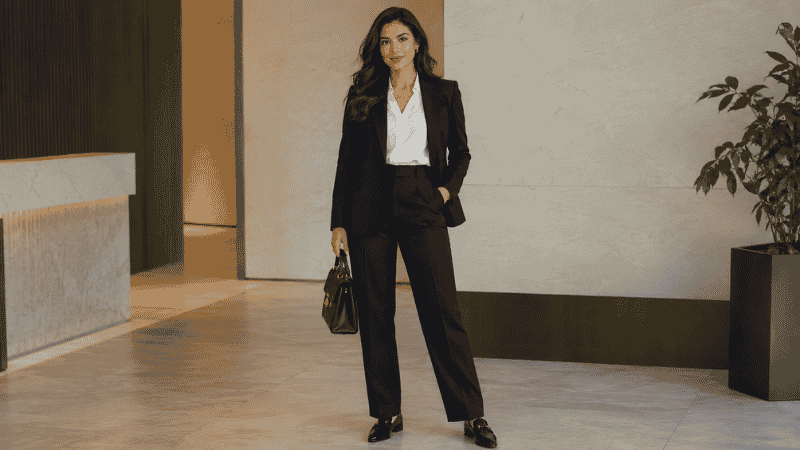
You got the interview. That’s the hard part — or it should be. But then you open your closet and realize you have absolutely no idea what to wear, and suddenly the interview itself feels easier than this. Do you wear the blazer? Is it too much? Is a dress professional enough? What if they’re business casual but you don’t know exactly what that means at this company specifically?
This is the real challenge of interview outfits for women: not finding something that looks good, but finding something that’s appropriately calibrated to a specific company culture you’re still trying to figure out. “Dress professionally” is advice that means something completely different if you’re interviewing at a corporate law firm versus a creative agency versus a healthcare clinic versus a tech startup. And getting it wrong in either direction — too formal or too casual — creates a first impression that’s hard to undo.
This guide solves the calibration problem. We’re organizing what to wear to a job interview by industry type — because that’s how you actually need to think about it — and covering body-type specific advice for petite and curvy women who face an extra layer of challenge when the standard “blazer and trousers” formula doesn’t fit right. We’re also covering what not to wear in honest, specific terms, because knowing the mistakes is as useful as knowing the formula.
Key Takeaways
- Research the company’s culture before choosing your outfit — look at employee photos on LinkedIn and the company website. What the team actually wears tells you more than any generic dress code advice.
- According to a 2023 CareerBuilder survey, 70% of hiring managers said a candidate’s appearance influenced their hiring decision — and being underdressed was viewed more negatively than being slightly overdressed
- The safest universal rule for any industry: one step more formal than what you observe employees wearing day-to-day — not two steps, not equal, one step up
- Fit matters more than formality. A well-fitting modest dress or a well-tailored blazer and trousers in a moderate price point will outperform an ill-fitting designer suit every time
- Navy, charcoal, camel, and soft white are the most universally appropriate interview colors across all industries — they read as professional without being severe, and they photograph well on video calls
- The interview outfit you want to avoid most: anything that requires constant adjustment. If you spent the morning pulling it, tucking it, or checking it, you’ll spend the interview doing the same — and that distraction shows
How to Research a Company’s Dress Code Before Your Interview
Before you decide what to wear, spend fifteen minutes doing this:
Step 1: Check the company’s LinkedIn. Look at employee photos — particularly the people who work in your department or at your level. If everyone is in a blazer and button-down, that tells you something. If everyone is in a t-shirt and jeans, that tells you something different.
Step 2: Check the company’s website “About” or “Team” page. This is often more curated than LinkedIn but still useful. Look for patterns in what people are wearing.
Step 3: Consider the role. Client-facing roles (sales, account management, consulting) typically require more formal dress than internal roles (engineering, product, design). Healthcare, legal, and finance skew more formal. Tech and creative industries skew significantly more casual.
Step 4: When in doubt, go one level up. If you think the office is business casual, dress business professional. If you think it’s smart casual, dress business casual. Being slightly overdressed signals respect for the opportunity. Being underdressed signals you didn’t think about it.
Interview Outfits by Industry: The Practical Guide
Corporate, Finance, and Law: Business Professional
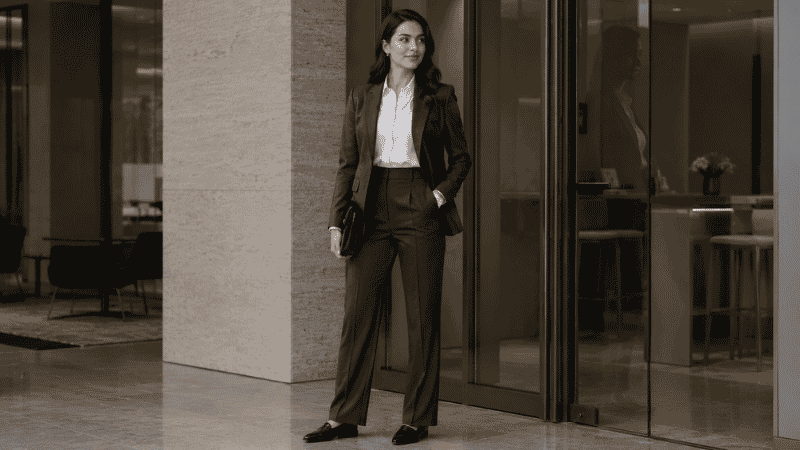
For interviews at investment banks, law firms, consulting firms, and corporate headquarters, the dress code expectation is business professional. This is the most formal interview context, and the margin for error is smallest.
What to wear:
A well-tailored blazer and trouser combination in navy, charcoal, or black — or a sheath dress in the same color palette with a blazer over the top. The fabric should be structured (wool, wool-blend, or ponte) rather than flowing. Everything should be pressed. Nothing should be wrinkled.
The specific formula: Tailored trousers in navy or charcoal + a silk or silk-feel blouse (white, cream, or light blue) + a matching or complementary blazer + pointed-toe heels or leather loafers + a structured leather bag. Minimal jewelry — a simple necklace, stud earrings, nothing that makes noise or catches light in a distracting way.
The blazer question: In corporate and legal contexts, yes — wear the blazer. This is not a creative agency. The blazer signals you understand the culture even before you walk in the door.
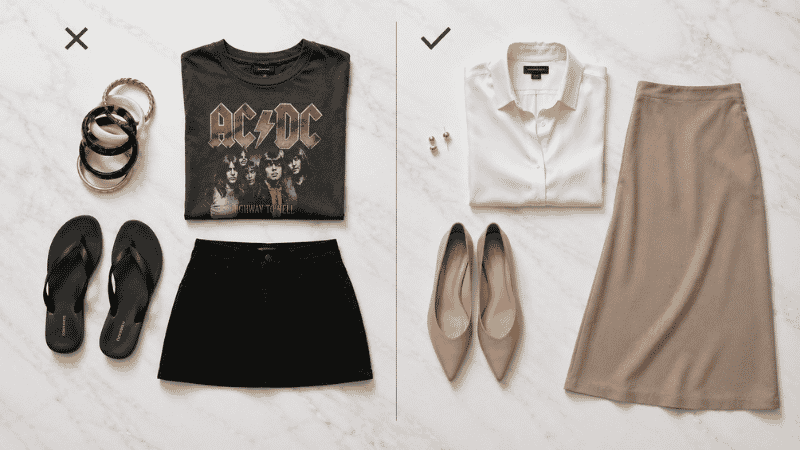
What not to wear: Open-toe shoes (conservative industries note footwear), very bright colors, anything with visible logos, anything that shows above the knee, anything wrinkled or lint-covered.
Budget note: For corporate and finance interviews specifically, the quality of your clothing matters more than in other industries. A well-fitting blazer in a mid-range fabric (a $60–$100 piece from ASOS, Banana Republic, or similar) looks significantly more appropriate than a very cheap blazer in a fabric that looks shiny or pilled. One well-fitting piece outperforms three budget pieces.
Business Casual Office: The Most Common and Most Confusing Dress Code
Most corporate interviews — HR, marketing, operations, mid-level office roles across most industries — fall into business casual territory. This is where most women get stuck, because “business casual” is genuinely inconsistent across companies.
The business casual interview interpretation:
For an interview, business casual means: polished, professional, clearly intentional — but not suit-level formal. The key word is polished. A casual dress that you’d wear to brunch is not business casual for an interview. A tailored midi dress in a solid color is.
What works:
- A tailored or structured midi dress in a solid neutral (navy, olive, camel, deep burgundy, soft white) + a blazer if the role skews professional, or without the blazer if the company is more relaxed
- High-waist tailored trousers + a fitted blouse (silk-feel or poplin) + pointed-toe flats or low-block-heel sandals
- A wrap dress in a solid color or a subtle print (nothing distracting) + heeled sandals or pointed-toe flats
The color principle: Solid colors read as more intentional and polished than prints for business casual interviews. If you choose a print, make it subtle — a fine stripe, a small geometric pattern. Avoid florals, bold graphics, or anything that would look more at home at a brunch than a boardroom.
What to avoid: Jeans (even dark, well-fitting jeans are risky for an interview unless you’re specifically told the dress code is casual), anything sleeveless without a layer over it, visible casual footwear (sneakers, flat sandals that read as beachwear).
Creative Industries: Smart Casual With Personality
Advertising agencies, design studios, marketing agencies, media companies, and creative departments of larger corporations have a very different relationship with interview dressing. Being too formal here can actually work against you — it signals you don’t understand the culture.
The creative industry interview principle: You want to look like you’d fit in, but on a slightly more intentional day than usual. Personal style is welcome — even expected. The goal is “I’m stylish and self-aware” rather than “I followed the corporate interview rulebook.”
What works:
- Dark-wash jeans or tailored trousers + a distinctive blouse or interesting top + clean sneakers, loafers, or ankle boots
- A printed or textured dress that shows personality without being distracting + interesting accessories
- A blazer over a simple outfit — but an interesting blazer (a check print, a colored blazer) rather than a standard navy one
The personality principle: In a creative interview, one piece with visual interest is appropriate and can even be a conversation starter. A printed blouse in an otherwise neutral outfit, a distinctive bag, a pair of earrings that are clearly intentional — these read as stylistically aware rather than loud.
What to avoid: Full suit (too stiff), very formal footwear (pumps in a creative agency read as out of touch), anything that looks like you grabbed the first professional-looking thing you own without thinking about whether it represents you.
Tech Industry: Smart Casual to Casual
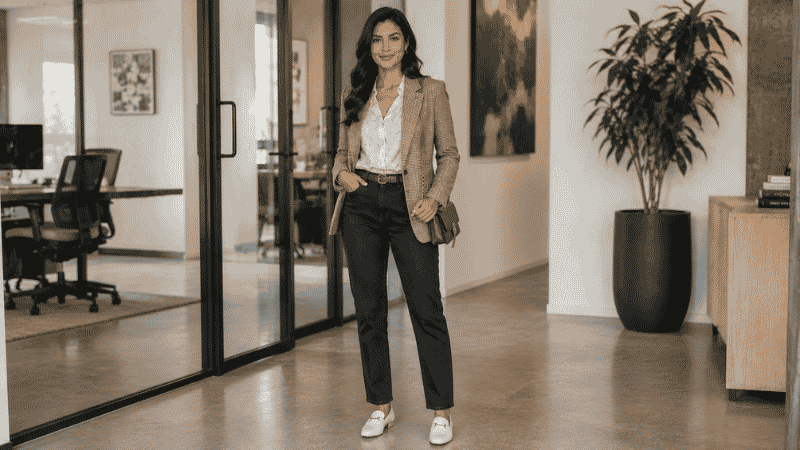
Tech companies — startups, FAANG companies, software companies of any size — have some of the most relaxed interview dress codes. Jeans are often completely appropriate. Suits are often uncomfortable for the interviewers to see.
The tech interview principle: You want to look like someone who belongs in a tech office, but who got dressed with intention today.
What works:
- Dark-wash or black straight-leg jeans + a fitted blouse or simple structured top + clean sneakers, loafers, or ankle boots
- Tailored casual trousers + a simple fitted top + clean footwear
- A simple dress in a casual-appropriate fabric (jersey, cotton) + flat sandals or loafers
What to avoid: A full suit or very formal dress — this signals a cultural misread. Very casual items — graphic tees, distressed jeans, athletic wear, anything too beachy.
Healthcare and Education: Practical Professional
Nursing, allied health, teaching, social work, and education roles have a specific interview dress code that standard corporate guides don’t address: you need to look professional but also like you understand the practical realities of the role.
What works:
- Tailored trousers or dark-wash jeans (for education/social work) + a fitted top + comfortable but polished flats or loafers
- A simple A-line or wrap dress in a solid color + comfortable flats
- For healthcare specifically: solid colors (patterns in healthcare settings can be confusing for patients), practical closed-toe footwear
The practical consideration: If you’re interviewing for a role that will involve physical activity, crouching, or extended standing, consider whether the outfit you’re wearing would work in those conditions. An interviewer in healthcare or education will notice whether you seem dressed for the practical reality of the job.
What Not to Wear to a Job Interview
Let’s be direct about this, because the fear of getting it wrong is often more acute than the desire to look great.
Anything that requires constant adjustment. If you spent the morning pulling down a hem, adjusting a neckline, or tucking in a top that won’t stay tucked, you will spend the interview doing the same. This is distracting — both to you and to the interviewer. Comfort and security in your clothing is not a luxury; it’s a professional necessity.
Overpowering fragrance. This sounds minor until you’re in a small conference room with someone who is visibly trying not to react to your perfume. Keep it minimal or skip it entirely for an interview.
Very revealing necklines or very short hemlines. Not because of any judgment about clothing itself, but because anything that makes an interviewer uncomfortable affects their ability to focus on your qualifications. The goal is to be remembered for your answers, not your outfit in either direction.
New shoes you haven’t broken in. You will likely be walking more than expected — parking, reception, multiple floors. New shoes that are creating blisters by the time you sit down for the interview will affect your comfort and your presence. Wear shoes you’ve worn before.
Anything that makes noise. Bangles that clank, shoes that click loudly on hard floors, jewelry that clinks with every movement — these are audio distractions in an already high-stakes conversation.
Visible logos or branding. This is particularly important in certain industries (don’t wear a competitor’s branded item). But even neutral logos can read as casual rather than professional in most interview contexts.
Very casual footwear. Flip flops, athletic trainers, very casual flat sandals — even if your outfit is professional, these signal that you didn’t think about the complete picture.
Interview Outfits by Body Type
For Petite Women: The Interview Proportion Formula
The standard interview advice — blazer and trousers — is designed for an average height frame. On a petite body, a standard blazer can hit at the thigh rather than the hip, disrupting the proportion entirely.
What works for petite interview dressing:
- A sheath dress or A-line midi dress that hits at or just below the knee — one piece removes the blazer proportion problem entirely. A well-fitting dress on a petite frame reads as more polished than a blazer-and-trouser combination that’s slightly off-proportion.
- Cropped blazers (ending at the natural waist) rather than hip-length blazers. The cropped version maintains the leg proportion that a longer blazer disrupts on a petite frame.
- High-waist tailored trousers with a fully tucked blouse — the high waist creates visual leg length.
- Pointed-toe flats or a small block heel — even 1–2 inches adds meaningful visual height and proportion.
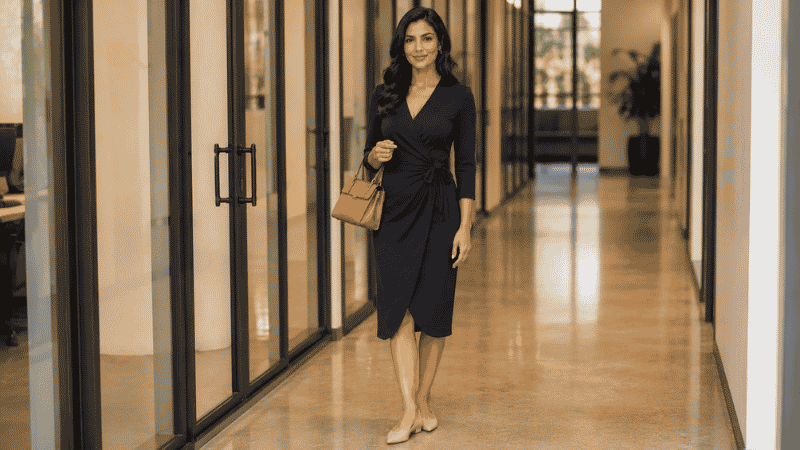
The petite interview shortcut: A well-fitting wrap dress in a solid color + pointed-toe flats in a neutral + small structured bag. One piece, complete, proportional, appropriate across most interview contexts.
For Curvy Women: The Interview Flattery Formula
The standard interview wardrobe assumption — slim blazer, fitted trousers — can be uncomfortable and unflattering for curvy bodies, particularly when standard sizing doesn’t account for hip-to-waist differentials.
What works for curvy interview dressing:
- A wrap dress in a structured or semi-structured fabric — the wrap silhouette creates a defined waist and accommodates curvy proportions without the fitting issues of a set-in blazer or rigid trouser waistband.
- High-waist tailored trousers with a fitted blazer — if you choose trousers, look for curvy-specific cuts (Abercrombie Curve Love, Madewell Curvy, NYDJ) that accommodate the hip-to-waist differential. Pair with a structured blazer rather than a very fitted blouse to create a polished, professional look.
- A sheath dress with a blazer over the top — the sheath creates structure; the blazer adds the formal layer. Look for sheath dresses with some stretch (ponte or scuba fabric) rather than rigid structured fabric.
The fabric note: For interview settings specifically, avoid very clingy or very light fabric in body-conscious silhouettes — not because there’s anything wrong with curves, but because both the clothing and the wearer tend to be more comfortable and confident in structured, supportive fabric over the course of a long interview process.

What to Wear to a Video Interview
Video interviews have become standard, and they have specific considerations that in-person interviews don’t.
The camera framing principle: The camera typically captures from the chest or waist up. This means your top half does the visual work entirely. A beautiful blazer or a polished blouse matters more than your trouser or skirt choice. That said — wear proper trousers or a skirt. Having to stand unexpectedly in a video interview happens, and being caught in pajama bottoms creates an impression that’s hard to undo.
Color on camera: Navy, cobalt, and jewel tones read beautifully on camera. Very bright white can create glare depending on your background. Very pale colors can wash out. Black works but can look flat without interesting accessories. A structured color — dusty rose, slate blue, forest green — reads particularly well in professional video settings.
The background consideration: Whatever you wear should contrast with your background rather than blending into it. If your background is white, avoid white tops. If it’s a dark bookshelf, avoid very dark colors.
The Emergency Interview Outfit Formula
Your interview is tomorrow. You haven’t thought about what to wear until now:
Step 1: Find your most polished, well-fitting dress or trouser-and-blouse combination. Not your most formal — your most polished. Clean, pressed, fits well, no pulls or pilling.
Step 2: Check the color — is it a neutral or near-neutral? If yes, proceed. If it’s very bright or patterned, look for a more neutral alternative.
Step 3: Add one structured layer if available — a blazer, a structured cardigan, or even a structured duster coat for more casual industries.
Step 4: Check the shoes — are they clean, polished, and closed-toe? If not, find a pair that are.
Step 5: Remove one accessory from whatever you’ve assembled. Interview accessories should be minimal — one earring, one necklace, one ring maximum. Less is more when you want the focus to be on what you’re saying.
Done. This isn’t the ideal process, but it works. The goal is polished and appropriate — not perfect.
FAQ: Interview Outfits for Women
What is the best outfit to wear to a job interview? A tailored midi dress in a solid neutral, or high-waist tailored trousers with a structured blouse and blazer. The specific choice depends on the industry — corporate and finance skew more formal; tech and creative skew more relaxed. Research the company’s culture before deciding.
Can I wear a dress to a job interview? Yes — a dress is often the most polished and well-proportioned option for an interview, particularly for petite women where the blazer-and-trouser combination can create proportion issues. A structured wrap dress, sheath dress, or A-line midi dress in a solid color is appropriate for most industries.
What colors should I wear to a job interview? Navy, charcoal, camel, and soft white are the most universally appropriate. These colors read as professional across all industries, complement most skin tones, and photograph well on video. Jewel tones (deep teal, forest green, burgundy) are also strong choices for business casual and creative environments.
Can I wear jeans to a job interview? Only in tech or very casual creative environments — and even then, they should be dark wash, well-fitting, and paired with an intentionally polished top and clean shoes. In corporate, finance, legal, healthcare, and most business casual environments, jeans are not appropriate for an interview regardless of the day-to-day office dress code.
What shoes should I wear to a job interview? Closed-toe pointed-toe flats, low-block heels, or leather loafers work for most interview contexts. Heels are not required — comfort and confidence matter more than height. Avoid open-toe shoes in very formal industries (finance, law), athletic trainers, and very casual flat sandals.
What should curvy women wear to a job interview? A wrap dress in a structured fabric, or high-waist curvy-fit tailored trousers with a structured blazer. Look for fabrics with some structure and stretch (ponte, scuba, stretch crepe) that move comfortably through a full day of interviews. Avoid very stiff or very clingy fabric.
What should petite women wear to a job interview? A sheath or wrap dress that hits just below the knee is the most reliably proportional interview choice for petite women — it removes the blazer-and-trouser proportion challenges. If you prefer separates, use a cropped blazer (ending at the natural waist) rather than a standard hip-length version, and high-waist trousers with pointed-toe footwear.
What to Read Next
- Work Outfits for Women: What Is Business Casual and How to Dress — once you get the job, this guide covers everyday office dressing by industry
- How to Dress for Your Body Type: The Complete Style Guide — the body type principles in this article go deeper in the full guide
- Best Jeans for Petite Women: The Inseam Guide — for tech and creative interviews where jeans are appropriate, this guide covers petite-specific fit
Sophie Hartwell covers practical, body-inclusive fashion for women navigating real occasions at TopChicWear.
References:
- CareerBuilder. (2023). Candidate Appearance and Hiring Decisions: Annual Recruiting Survey. CareerBuilder LLC.
- Howlett, N., Pine, K., Orakçıoğlu, İ., & Fletcher, B. (2013). The influence of clothing on first impressions. Journal of Fashion Marketing and Management, 17(1), 38–48.
- Slepian, M. L., Ferber, S. N., Gold, J. M., & Rutchick, A. M. (2015). The cognitive consequences of formal clothing. Social Psychological and Personality Science, 6(6), 661–668.