
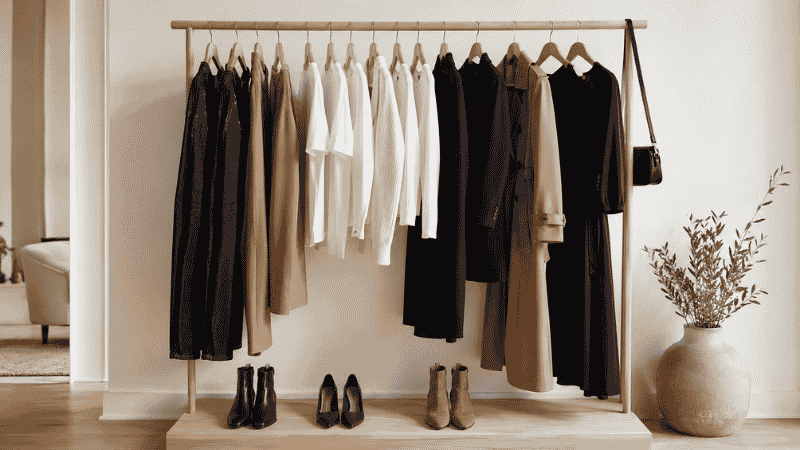
You’ve read the guides. You know the concept. A small, curated collection of versatile pieces that work together to create endless outfits, eliminate morning decision fatigue, and somehow make you feel more stylish with less stuff. The idea is genuinely appealing. And then you try to implement it and realize that the “10 essential pieces every woman needs” list includes a cashmere turtleneck, a silk blouse, and a pair of wide-leg tailored trousers in a fabric that needs dry cleaning — and none of it sounds like your actual life.
Here’s the thing about capsule wardrobes for women: the concept works, but most guides get the starting point wrong. They start with a shopping list. Your capsule wardrobe shouldn’t start with a shopping list. It should start with your existing closet, your actual lifestyle, and an honest look at what you genuinely wear versus what you own out of guilt or aspiration.
This guide builds a capsule wardrobe the way it actually works in practice — starting with what you have, identifying what’s missing, and buying strategically only for the gaps. We’ll also cover how to build one on a realistic budget, how to adapt it to different lifestyles (because a student’s capsule and a corporate professional’s capsule look nothing alike), and how to make the capsule work for your specific body type.
Key Takeaways
- A capsule wardrobe is not a shopping list — it’s a curation process that starts with your existing wardrobe, not a store
- According to a 2023 McKinsey & Company consumer report, the average woman wears only 20% of her wardrobe on a regular basis — the goal of a capsule is to make that 20% intentional and high-functioning
- The number of pieces in your capsule matters less than the combination potential — 15 pieces that work together in every configuration are worth more than 40 pieces that each only work with two others
- A realistic starter capsule for most women: 10–15 pieces covering tops, bottoms, one dress, one outer layer, and two pairs of shoes — not the 37-piece lists you see online
- Body type matters when building a capsule — your capsule bottoms should be cuts that flatter your specific proportions, not generic “classic straight-leg jeans” if that cut doesn’t work on your frame
- The most common capsule wardrobe mistake: buying all new pieces instead of auditing what you already own first
Step 1: Audit Before You Shop (The Part Every Guide Skips)
The first step in building a capsule wardrobe isn’t buying anything. It’s figuring out what you actually have and what you actually wear.
Pull everything out of your closet. Not some things — everything. Lay it on the bed or hang it on a rack. Now look at it honestly.
The three-pile method:
Pile 1: Things you actually wear. Reached for regularly, feel good in, fit well. These are your capsule candidates. Don’t edit this pile yet.
Pile 2: Things you want to wear but don’t. The silk blouse that’s dry-clean only. The jeans that fit when you bought them but now need constant adjusting. The blazer that was on sale and seemed like a great idea. Be honest here. “I might wear it someday” is not “I wear it.”
Pile 3: Things you don’t wear and know you won’t. These leave the closet. Donate, sell, or store.
After the audit, look at Pile 1. This is your actual wardrobe. Notice the patterns: what colors do you gravitate toward? What silhouettes? What occasions? The answers tell you more about your personal capsule than any “10 essentials” list.
The common audit revelation: Most women discover they already own the bones of a capsule wardrobe — they’re just buried under Pile 2 and Pile 3 items that create visual noise and decision fatigue.

Step 2: Define Your Actual Lifestyle (Not Your Aspirational One)
This is where most capsule wardrobe attempts go wrong. You build for the life you want to have rather than the life you actually have.
The honest lifestyle audit:
How many days per week do you go to an office? How many days are genuinely casual — running errands, working from home, weekend activities? How often do you have evening events that require something beyond jeans and a top? How often do you exercise in clothes that are also your regular clothes?
The answers create your proportion formula.
For students and work-from-home women: Your capsule should lean heavily casual — 60-70% of pieces should be comfortable, versatile, and appropriate for sitting at a desk or being out in the world without a formal dress code. You don’t need four blazers.
For office professionals (5 days/week in person): Your capsule needs enough polished pieces to cover a full work week without repeating in a way that feels monotonous. Roughly 50-60% of pieces should be work-appropriate, with the rest covering weekends and evenings.
For everyone in between: The mix reflects your actual split. If you’re in the office three days and working from home two, build accordingly — not for five days of office dressing.
The aspirational wardrobe trap: Many women build a capsule for the version of their life where they go to more gallery openings, dinner parties, and sophisticated events than they actually attend. You don’t need that silk midi dress for the three times a year you might wear it. You need great pieces for the life you’re actually living.
How to Build a Capsule Wardrobe: The Actual Formula
Once you’ve done the audit and the lifestyle assessment, building the capsule becomes straightforward. Here’s the formula that works across most lifestyles:
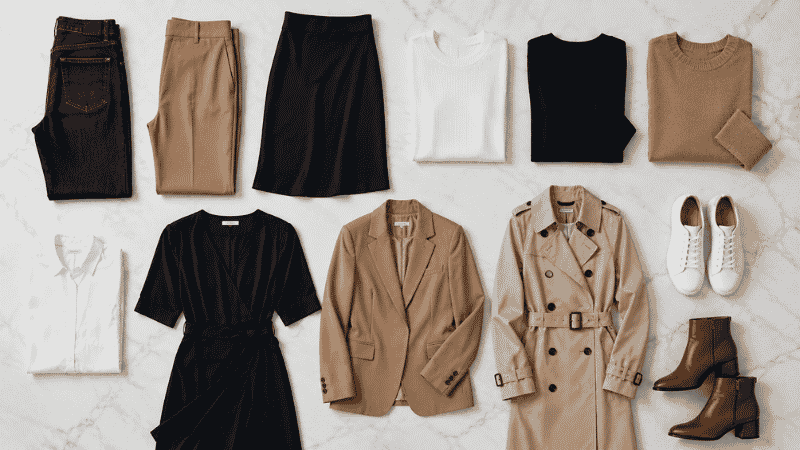
The Foundation: Bottoms (3 pieces)
Three bottoms cover the majority of outfit combinations. The specific pieces depend on your lifestyle, but the principle is:
One versatile trouser or jean — the workhorse bottom that works for both casual and polished settings. For most women, this is a high-rise dark-wash straight-leg jean or a pair of tailored trousers in a neutral. This piece should work with every top in your capsule.
One occasion-specific bottom — a midi skirt, wide-leg trousers, or a more formal trouser that handles elevated casual, work presentations, or evenings out. This is the bottom you reach for when the first bottom isn’t right for the setting.
One truly casual bottom — shorts, casual trousers, or a second pair of jeans in a different wash. This is what you wear on genuinely relaxed days.
The Foundation: Tops (4-5 pieces)
Four or five tops that work in multiple combinations with all three of your bottoms. The color logic: neutrals first (white, cream, black, grey, navy), accent colors second if you want them. Every top should work with at least two of your bottoms.
A fitted white or cream top — the most versatile single piece in any capsule. Works under blazers, alone with jeans, under a midi skirt, layered under a cardigan.
A fitted black or dark top — the high-contrast alternative. Tucked into lighter bottoms, worn alone with dark bottoms for a monochromatic look.
A knit or sweater in a warm neutral — camel, tan, or a soft grey. The cozy layer that elevates any bottom.
A blouse or slightly elevated top — something that reads as “I made an effort” for work or evening settings. This is your one top that isn’t purely casual.
Optional fifth top — a pattern, a pop of color, or a second blouse that expands the combination options.
The Foundation: Dress (1 piece)
One dress that handles multiple scenarios. The criteria: appropriate for a work day with flats, appropriate for an evening out with heels, appropriate for a casual weekend with sneakers. This is a significant ask, but a well-chosen wrap dress or a clean midi dress in a solid color covers all three.
The Foundation: Outer Layer (1-2 pieces)
One structured outer layer that elevates any outfit underneath — a classic blazer, a structured cardigan, or a trench coat. This is the piece that turns “I’m wearing jeans and a top” into “I’m wearing an outfit.”
A second outer layer for cold weather if your climate requires it — a wool coat or a heavier jacket.
The Foundation: Shoes (2-3 pairs)
Two pairs of shoes covers most situations. Three is ideal.
Pair 1: A versatile, walkable everyday shoe — clean white sneakers, leather loafers, or simple flat sandals. This is what you wear 80% of the time.
Pair 2: A slightly elevated shoe for work and evening — a pointed-toe flat, a block-heel sandal, or an ankle boot. This pair makes outfits look intentional.
Pair 3 (optional): A weather-specific or activity-specific shoe — boots for winter, a casual sandal for summer.
The Color Rule: Why Your Capsule Needs a Palette
This is the piece of capsule wardrobe logic that makes everything else work.
Every piece in your capsule should work with every other piece in your capsule. The only reliable way to achieve this is a consistent color palette — not identical colors, but colors that all work together.
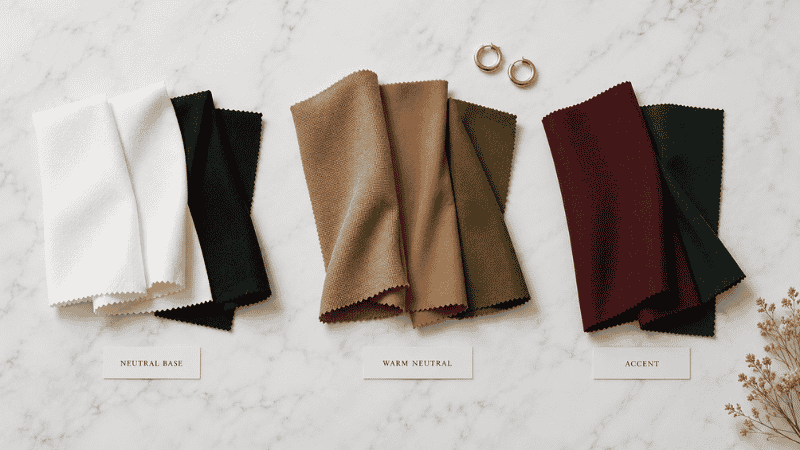
The three-color approach:
One neutral base — white, cream, black, navy, or grey. Most of your tops and several of your bottoms live here.
One warm neutral — camel, tan, khaki, or olive. Your second bottom, your knit top, and potentially your outer layer.
One accent — a color that works with both of the above. Burgundy, forest green, cobalt, or rust are all reliable capsule accents that photograph well and work across seasons.
The test: Can every piece in your capsule be worn with at least three other pieces in the capsule? If yes, your palette is working. If you have items that only work with one or two other things, they’re not earning their spot.
Capsule Wardrobe on a Budget: How to Fill Gaps Without Overspending
Once you’ve audited your existing wardrobe and identified what’s missing, you’re shopping with a specific list rather than browsing. This changes everything about how much you spend.
The gap list approach: You need exactly one fitted cream top, one pair of tailored trousers in camel, and one structured blazer. Those are your three purchases. You’re not shopping “for a capsule” — you’re solving three specific problems.
Where to shop by budget:
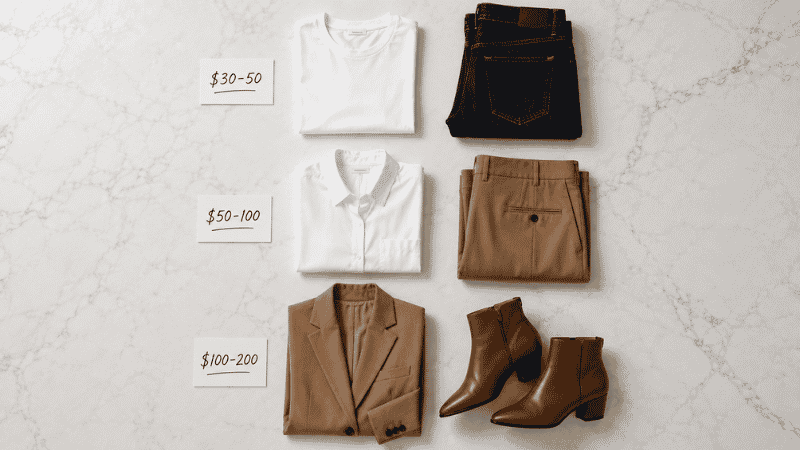
Under $50 per piece: Amazon (read reviews obsessively, check return policy before buying), ASOS (wide selection, genuine quality range — read reviews by item not by brand), Target’s A New Day and Universal Thread lines, and Thrift/Poshmark for specific items.
$50-$100 per piece: ASOS mid-range, Gap, Uniqlo (particularly for basics — their fitted tees, fine-knit sweaters, and trousers punch significantly above their price point), and Mango.
$100-$200 per piece: Quince (cashmere and linen basics at significantly below market price), Everlane, Madewell, and & Other Stories. At this range, you’re buying pieces that will last 3-5+ years if cared for.
The investment logic: In a capsule wardrobe, each piece gets significantly more use than in a full wardrobe. A $100 pair of tailored trousers you wear three times a week costs less per wear than a $30 pair you wear twice and donate. Spend more on the highest-frequency pieces; spend less on the lower-frequency ones.
Capsule Wardrobe by Body Type: The Adjustments
The generic capsule wardrobe list assumes a specific body type and height. Here’s how to adapt it.

For Petite Women
The capsule foundation pieces are the same, but the specific cuts matter more. For your trouser, prioritize high-rise over mid-rise (creates leg length), and look for petite-specific inseams rather than hemming standard lengths. For your blazer, a cropped version (ending at the natural waist) is more proportional than a hip-length standard. For your outer coat, a hip-length rather than full-length version maintains leg proportion.
Your dress should hit at or just below the knee rather than mid-calf — on a petite frame, mid-calf can read as heavy. A wrap dress or A-line style creates vertical length through the torso.
For Curvy Women
Your bottoms need to fit your largest measurement first — buy for the hip, not the waist. High-rise in every bottom style. For your trouser, look for curvy-specific fits (Madewell Curvy, Abercrombie Curve Love) rather than standard sizes that gap at the waist. Your dress should be a wrap style — it accommodates curvy proportions through construction rather than requiring precise sizing.
For your outer layer, a structured blazer that fits the shoulders and drapes over the rest is more flattering than a very fitted version that requires matching the hip measurement precisely.
For Tall Women
Your trouser needs a minimum 34″ inseam — don’t buy standard and hem, buy tall sizing. Your dress should be a midi rather than a “midi-for-average” that hits above the knee on your frame. ASOS Tall, Gap Tall, and Good American are your most reliable sources for pieces that actually fit.
What a Starter Capsule Actually Looks Like
Here’s a concrete 12-piece capsule that works for a woman with a mixed lifestyle (some office, some casual, some evenings):
Bottoms:
- High-rise dark-wash straight-leg jeans
- Tailored camel or olive trousers
- A midi skirt in a neutral (black, navy, or a subtle print)
Tops:
- Fitted white ribbed crewneck or tank
- Fitted black or cream long-sleeve top
- Fine-knit camel or neutral sweater
- A blouse in a slightly elevated fabric (silk-feel or woven)
Dress:
- Wrap midi dress in a solid jewel tone
Outer Layers:
- Structured blazer in camel or black
- Trench coat or wool coat (climate-dependent)
Shoes:
- White leather sneakers or leather loafers (everyday)
- Pointed-toe flats or block-heel ankle boots (elevated)
How many outfits does this generate? Conservative estimate: 25-30 complete outfits. Every top works with every bottom. The dress stands alone or layers with the blazer. The outer layers complete any combination. This is the matrix effect that makes a capsule wardrobe functional rather than just conceptually appealing.
The Capsule Wardrobe Maintenance Rule
A capsule wardrobe isn’t a one-time project — it’s an ongoing practice. Once you have the capsule working, the maintenance rule is simple: one in, one out. When you buy a new piece, something leaves the capsule. This prevents the slow accumulation that turns a 15-piece capsule into a 40-piece semi-organized mess over two years.
The seasonal refresh is also real — your 12-piece summer capsule looks different from your 12-piece winter capsule, and that’s correct. The bones are the same (your color palette, your combination logic, your lifestyle-appropriate proportions), but specific pieces rotate for weather appropriateness.
FAQ: Capsule Wardrobe for Women
How many pieces should a capsule wardrobe have? 10–15 pieces is a realistic starter capsule for most women, though the number matters less than the combination potential. Every piece should work with at least three other pieces in the capsule. A 15-piece capsule where everything works together creates more outfit options than a 40-piece wardrobe where pieces only pair with one or two others.
How do I build a capsule wardrobe on a budget? Start with what you already own — audit your closet and identify what actually gets worn. Then shop specifically for the gaps, not generally for “a capsule.” Uniqlo, Gap, and ASOS offer reliable quality in the $30–$80 range. Poshmark and ThredUp have secondhand options for higher-quality pieces at lower prices. Buy your highest-frequency pieces at a higher price point; save on lower-frequency ones.
What are the essential pieces for a women’s capsule wardrobe? The specific pieces depend on your lifestyle, but the structure is: 3 bottoms (one versatile, one elevated, one casual), 4-5 tops in your neutral palette, 1 dress that works across settings, 1-2 outer layers, and 2-3 pairs of shoes. The “10 essentials every woman needs” lists are a starting point — adapt them to your actual life, not a generic ideal.
How do I know if my capsule wardrobe is working? If you can get dressed in under 10 minutes for any scenario in your daily life without feeling like you have “nothing to wear,” your capsule is working. If you’re still standing in front of your closet frustrated, something in the combination potential isn’t right — usually it’s a color palette issue (pieces that don’t work together) or a lifestyle-proportion issue (too many pieces for scenarios you rarely encounter).
Can you have a capsule wardrobe if you have a curvy or petite body? Yes — the structure is the same, but the specific cuts matter more. For petite women: high-rise bottoms, cropped outer layers, and pieces in petite-specific lengths. For curvy women: high-rise bottoms in curvy-specific fits, wrap-style dresses, and structured blazers that fit the shoulders. The capsule wardrobe works for every body type when the pieces are chosen for your proportions rather than a generic ideal.
What to Read Next
- How to Dress for Your Body Type: The Complete Style Guide — build your capsule around pieces that work for your specific proportions
- Best Jeans for Curvy Women: The Complete Fit Guide — finding the right capsule bottom if you have curves
- Best Jeans for Petite Women: The Inseam Guide — finding the right capsule bottom if you’re petite
- Linen Pants for Women: How to Style Them — linen pants are one of the most versatile capsule wardrobe pieces; this guide covers every way to wear them
- Work Outfits for Women: What Is Business Casual — how to build the work-appropriate portion of your capsule
Sophie Hartwell covers practical, body-inclusive style advice for women who want their wardrobes to actually work at TopChicWear.
References:
- McKinsey & Company. (2023). The State of Fashion: Consumer Closet Audit Data. McKinsey Global Institute.
- Koehler, A. (2024). Why I Hate Capsule Wardrobes. Off the Cuff Newsletter. Citing wardrobe psychology research.
- Rantanen, E., & Goldsmith, R. E. (2009). Wardrobe planning and consumer satisfaction. Journal of Consumer Behaviour, 8(6), 292–307.