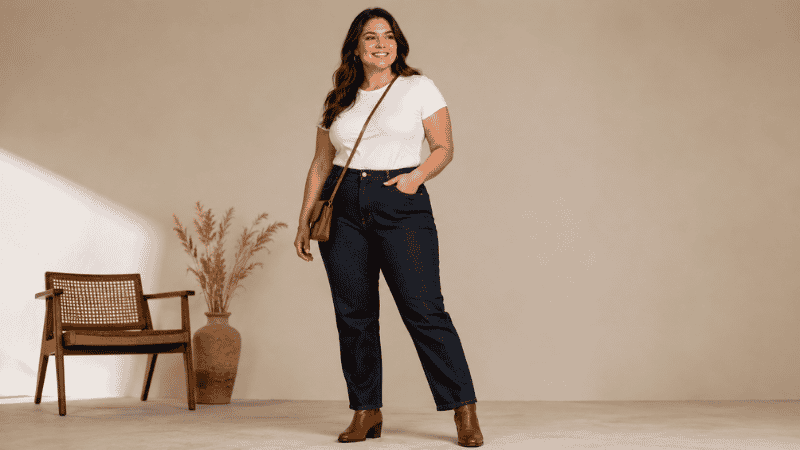
You’ve been there. You pull on a pair of jeans that fit perfectly in the thighs, and then you turn around and there’s a two-inch gap at the back waistband. Or you size up to get the hips in, and suddenly the waist is enormous and the thighs are still tight. Or everything fits, and then you sit down and the waistband cuts into your stomach for the next eight hours.
Finding the best jeans for curvy women is genuinely harder than it should be — not because the options don’t exist, but because most guides just hand you a brand list without explaining why a particular fit works for a curvy body. So you buy the recommendation, it doesn’t work for your specific proportions, and you end up back at square one.
This guide works differently. We’re starting with the logic — what to look for in jeans and why it matters for curves — before we get to specific recommendations. Because once you understand what a contoured waistband actually does, or why rise height matters more than cut for preventing waist gap, you can evaluate any pair of jeans at any price point and know whether it’s worth trying. The brand recommendations are real and tested, but the logic is what makes them useful.
Key Takeaways
- The single most important feature for curvy women’s jeans: a contoured waistband (sometimes called a “curvy waistband” or “no-gap waistband”) — this is the construction detail that eliminates waist gap without requiring you to go up multiple sizes
- For jeans that fit curvy bodies properly: look for 2–3% elastane content — enough stretch to accommodate hip-to-waist ratio difference without losing shape after a few wears
- High-rise (10–12″ front rise) is the most universally flattering rise for curvy bodies — it sits above the fullest part of the hip, creates waist definition, and prevents the “sausage casing” effect of a mid-rise on a curvy frame
- According to a 2023 Mintel fashion report, over 68% of women report fit as their #1 challenge when shopping for jeans — significantly higher for women who identify as curvy or plus-size
- The best jeans for small waist big hips: look specifically for “curvy fit” labeling with extra room in the hip and thigh and a smaller waist measurement — not just standard sizing scaled up
- Waist gap is almost never a sizing problem — it’s a cut problem. Buying a smaller size won’t fix it; finding a curvy-specific cut will.
The Curvy Jeans Fit Logic: What to Actually Look For
Before any brand recommendation, you need to know what you’re looking for on a label or product description. These are the four features that determine whether a jean will fit a curvy body well.
Rise Height: The Most Important Number
Rise is the measurement from the crotch seam to the top of the waistband. For curvy bodies, this number matters more than almost anything else.
Low-rise (under 9″): Generally unflattering for curvy bodies — sits at the fullest part of the hip and often creates a “muffin top” effect even on women who don’t have significant belly weight. Avoid.
Mid-rise (9–10″): Can work on hourglass figures where the hip-to-waist ratio is proportional, but often creates waist gap on pear and rectangular body types where the hips are significantly wider than the waist.
High-rise (10–11″): The sweet spot for most curvy bodies. Sits above the fullest part of the hip, creates natural waist definition, and prevents the waistband from cutting across the widest measurement.
Super-high rise (12″+): Ideal for apple shapes and anyone who carries weight in the midsection — the extra coverage creates a smoother line. Also excellent for small waist/big hips proportions because the longer rise accommodates the hip curve without gaping at the waist.
The Contoured Waistband: The Feature That Changes Everything
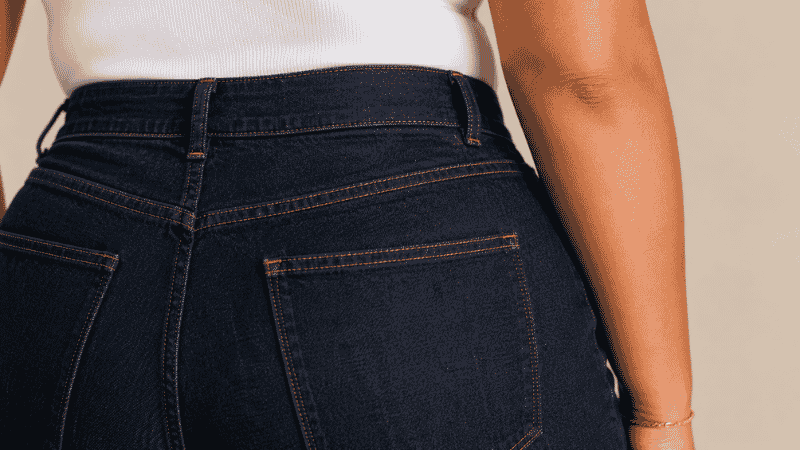
A contoured waistband (different brands call it “no-gap waistband,” “curvy waistband,” or “comfort waistband”) is curved rather than straight at the back. This single construction detail is the difference between jeans that gap at the waist and jeans that sit flat.
Why standard waistbands gap: Most jeans are designed with a straight waistband, which works for bodies where the waist and hip measurements are proportionally similar. When your hips are significantly wider than your waist — which is the definition of a curvy figure — a straight waistband either fits the hip (and gaps at the waist) or fits the waist (and can’t get over the hip).
How contoured waistbands solve it: The curve in the waistband follows the curve of a body with a significant hip-to-waist differential. It’s a design solution, not a compromise. If waist gap is your primary jeans complaint, filter specifically for “contoured waistband” or “curvy fit” on any retailer.
Stretch Content: The Right Amount Matters
Too little stretch and the jeans won’t accommodate curves. Too much stretch and they lose their shape by mid-afternoon.
The ideal range: 2–3% elastane (Lycra, spandex). This provides enough give to move with the body without the fabric bagging out at the knees and seat after a few hours of wear.
What to avoid: 0% elastane (rigid denim) in fitted cuts — it doesn’t move with curves and creates uncomfortable pressure points. Also avoid very high elastane (5%+) in anything labeled as “denim” — these feel more like jeggings and lose their shape quickly.
The “snap back” test: Good stretch denim should return to its original shape after being stretched. Cheap high-elastane fabric will stay stretched — this is why your jeggings bag at the knees by noon.
Thigh Room: The Measurement Nobody Talks About
The thigh measurement is where most curvy women’s jean fits break down. Standard cuts are designed for a specific thigh-to-hip ratio, and curvy bodies often have fuller thighs relative to that ratio.
What to look for: Product descriptions that specifically mention “extra room in the thigh and seat,” “relaxed through the thigh,” or brands that offer specific curvy cuts (not just plus sizing).
The important distinction: Plus sizing and curvy sizing are not the same thing. Plus sizing scales up every measurement proportionally. Curvy sizing is designed with a higher hip-to-waist ratio and more room specifically in the thigh and seat — the measurements that matter for curvy fit.
Best Jeans for Curvy Women by Cut
High-Rise Straight-Leg Jeans: The Most Universally Flattering
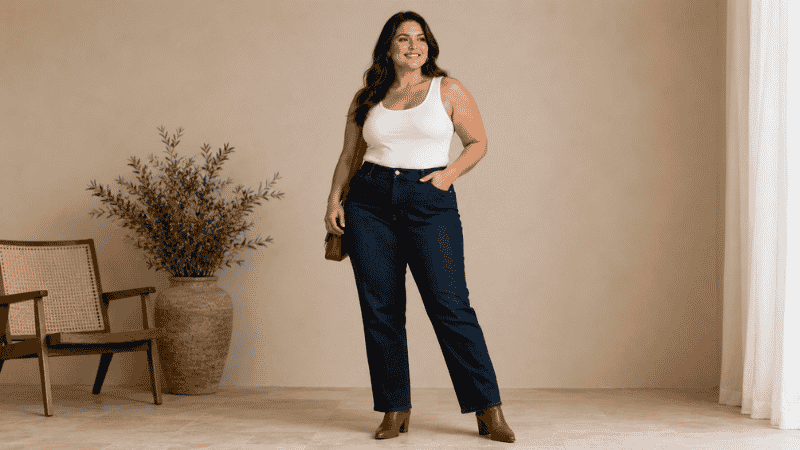
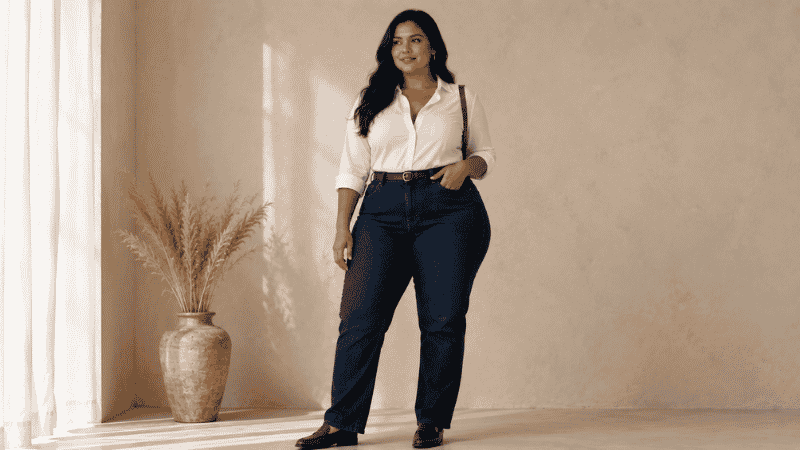
The high-rise straight-leg is the curvy body workhorse. The high rise creates waist definition and sits above the fullest hip point; the straight leg skims from hip to ankle without clinging or flaring.
Why it works for curvy bodies: The straight leg creates a continuous vertical line from hip to ankle, which visually elongates the silhouette. It doesn’t add volume at the hip (like a wide-leg) or create contrast at the ankle (like a bootcut or flare). It’s the jeans equivalent of a clean, unbroken vertical line.
The styling formula: High-rise straight-leg jeans + a fitted top tucked in + a simple shoe. The tucked top emphasizes the defined waist that the high rise creates. Nothing else is required.
Best brands at this cut: Madewell (specifically the Curvy High-Rise Stovepipe, designed with extra room in the hip and thigh), Abercrombie & Fitch (Curve Love line has a contoured waistband), Good American (designed specifically for curvy bodies at every size, significant stretch recovery).
Wide-Leg Jeans for Curvy Women: The Statement Option
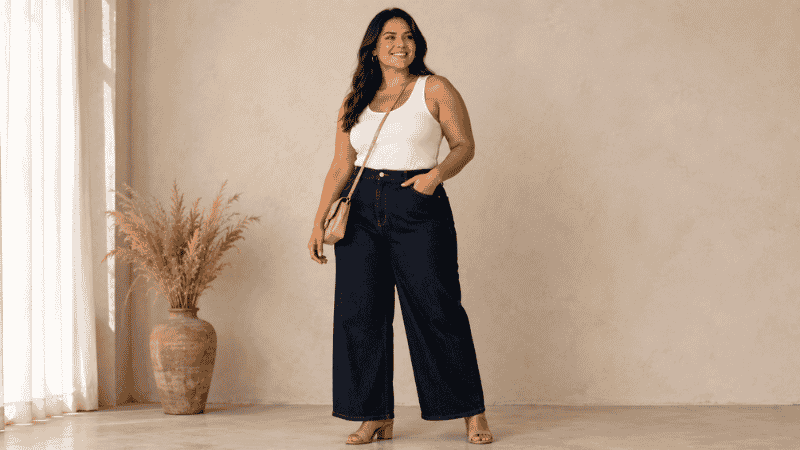
Wide-leg jeans have become one of the most popular curvy denim choices because the relaxed silhouette doesn’t require the jeans to conform precisely to every curve — they drape over the hip rather than against it.
Why it works: Wide-leg denim doesn’t grip the thigh, which eliminates the chafing and fit inconsistency that thinner cuts create for fuller thighs. The volume of the leg also creates visual balance — a wide leg visually balances wider hips by adding corresponding volume at the hem.
The non-negotiable styling rule: Wide-leg jeans + fitted top, always. The proportional rule is as true for jeans as it is for linen pants. A loose top over wide-leg jeans on a curvy frame reads as shapeless. A fitted tank tucked into wide-leg jeans creates intentional contrast between the defined waist and the flowing leg.
The shoe note: Wide-leg jeans need height at the shoe to work well — a block heel, a wedge, or at minimum a platform sneaker. Flat sandals under wide-leg jeans often make them drag and the proportion feels off.
Bootcut and Flare Jeans for Curvy Women: The Balancing Act
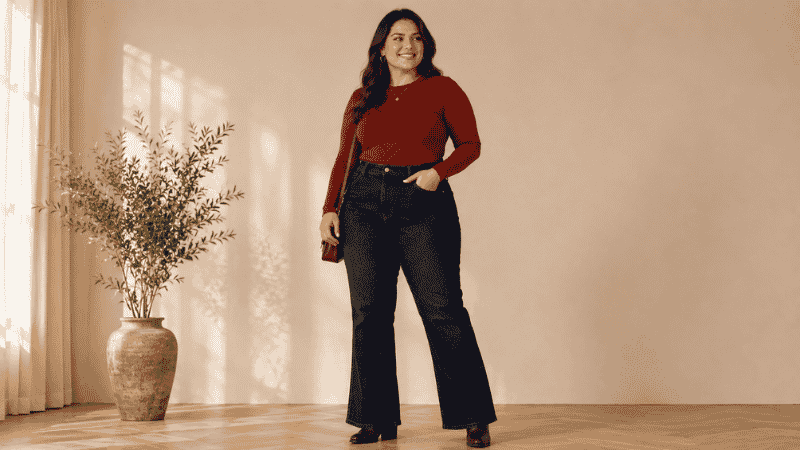
Bootcut and flare jeans are particularly effective for pear-shaped bodies because the flare at the hem creates visual balance with wider hips. The wider hem draws the eye downward and outward, making the hips appear more proportionate in the overall silhouette.
The specific benefit for pear shapes: If your hips are your widest measurement, a flare at the hem creates visual symmetry — the eye sees “wider at the top, wider at the bottom” and reads the middle as proportional rather than the waist as narrow relative to the hip.
Styling note: Bootcut works best with a heel or a chunky boot that fills the opening of the flare. A narrow shoe inside a bootcut hem creates a visual gap that looks unintentional.
Specific Pain Points: The Solutions
Best Jeans for Small Waist Big Hips
This is the classic curvy body challenge — the hip-to-waist differential that makes standard sizing impossible. Buy for the hip and the waist gaps; buy for the waist and you can’t get the jeans on.
The solution is not sizing — it’s cut. Specifically:
- Look for jeans labeled “curvy fit,” “curve love,” or “no-gap waistband” — these are designed with extra width in the hip and a smaller waist relative to the hip measurement
- Rise should be high (10″+) — the longer rise gives the fabric more room to accommodate the hip curve before reaching the waist
- A contoured waistband is non-negotiable for this body type
- The Abercrombie Curve Love line and Madewell Curvy fits are designed specifically for this proportion — the waist runs smaller relative to the hip than in their standard cuts
The alteration option: If you find a pair that fits perfectly in the hip and thigh but gaps at the waist by 1–2 inches, a tailor can take in the waistband for $15–$25. This is significantly cheaper than continuing to search for the perfect pair.
Best Jeans for Thick Thighs
Thick thighs are often what pushes curvy women into sizing up past what they need — the thighs don’t fit, so they go up a size, and then the waist is enormous.
What to look for specifically:
- Product descriptions that mention “relaxed through the thigh and seat” or “extra room in the thigh”
- Avoid skinny jeans in stiff denim — the rigid fabric against fuller thighs creates pressure points and discomfort over a full day
- Straight-leg or wide-leg cuts with a slightly relaxed thigh (not a fitted thigh) are the most comfortable
- A 2–3% elastane content that allows the fabric to move with the thigh rather than against it
The chub rub solution: If inner thigh friction is an issue, a thigh-length slip short (Thigh Society makes these specifically for this purpose) worn under any jeans eliminates the problem without changing the outfit.
Best Jeans for Muffin Top
Muffin top — the fold of fabric over the waistband — is almost entirely a rise problem, not a weight problem. It happens when the waistband sits at or slightly below the widest measurement of the midsection.
The solution: Go up in rise, not up in size. A super-high rise (12″+) that sits well above the midsection creates a smooth line rather than a fold. The fabric compression at the high waist actually smooths the midsection rather than creating a fold over the top.
What specifically works:
- Good American jeans (designed with a high rise that smooths rather than cuts)
- Abercrombie Curve Love high-rise styles
- Spanx denim (has built-in shaping through the waistband and midsection)
- NYDJ (specifically designed with “lift tuck technology” at the waistband)
Editor’s note: If you’re experiencing muffin top in high-rise jeans, the jeans are too tight in the waist — you need to size up or find a curvy cut. Muffin top in a properly fitting high-rise jean (where the waistband sits flat without digging in) is extremely rare.
Best Jeans for Big Hips
Big hips in the context of jeans usually means one of two things: very full hips relative to the waist (the small waist/big hips situation above) or full hips with a proportional waist (where standard sizing often fits but the jeans feel tight across the hip seat).
For very full hips: The contoured waistband + high rise formula above applies. Additionally, look for jeans where the hip measurement in the size chart is 2″+ larger than the waist measurement — this indicates a curvy cut rather than a standard cut.
For full hips with proportional waist: You likely fit into standard sizing but need extra room in the seat. Look for “relaxed seat” or “roomier in the seat and thigh” in the description. Boyfriend-cut jeans and relaxed straight-leg cuts accommodate a fuller seat without requiring you to go up multiple sizes.
Best Jeans for Curvy Women by Body Shape
Jeans for Hourglass Figure
Hourglass figures have proportionally similar shoulders and hips with a significantly smaller waist — the curvy body type most designers have started designing for specifically.
What works: Almost any cut works on an hourglass if the rise is high and the waistband accommodates the hip-to-waist differential. High-rise skinny, high-rise straight, high-rise flare — all create a defined waist when the rise sits correctly.
Best cut: High-rise skinny or slim-straight in a stretch denim — these showcase the hourglass proportion most clearly. The fitted cut from hip to ankle emphasizes the shape rather than hiding it.
What to avoid: Low-rise anything — it cuts across the hip at the widest point rather than defining the waist.
Jeans for Pear Shaped Women
Pear shape means hips and thighs are fuller than the upper body. The goal with jeans for pear shapes is to minimize the hip-to-shoulder contrast while creating a defined waist.
What works:
- High-rise with a contoured waistband — essential for accommodating the hip-to-waist differential
- Bootcut and flare styles that add volume at the hem to balance the hip
- Straight-leg in a dark wash — the dark wash and clean line create a streamlined lower half
- A slightly wider leg opening that mirrors the hip width rather than contrasting with it
What to avoid: Skinny jeans with a lot of contrast between the tight thigh and the narrowing ankle — this emphasizes the pear shape rather than balancing it. Also avoid very light wash jeans, which draw attention to the lower half.
Styling note for pear shapes: Pair jeans with tops that add volume to the upper body — an off-shoulder top, a puff-sleeve blouse, a structured blazer with strong shoulders. The goal is balance between top and bottom.
Jeans for Curvy Apple Shape
Apple shapes carry more weight in the midsection than the hips — the challenge with jeans for apple shapes is creating the illusion of a defined waist while accommodating the midsection comfortably.
What works:
- Super-high rise (12″+) that sits well above the midsection — creates compression and a smooth line
- Slight stretch in the fabric to accommodate the midsection without creating a rigid band
- Dark wash — visually streamlines the lower half
- A straight or slightly relaxed leg — neither adds volume (wide-leg) nor creates a contrast at the ankle that draws the eye upward (bootcut)
What to avoid: Anything that cuts across the midsection at its widest point — this means low-rise and mid-rise jeans that sit at the belly rather than above it.
Brands by Budget: The Honest Breakdown
Under $60 (Amazon, ASOS, Walmart)
Amazon has improved significantly in the curvy denim category. Look for brands that specifically mention “curvy fit” or “no-gap waistband” in their listing, and read reviews from women who mention their body measurements. ASOS has a dedicated Curve line that runs up to size 30 and uses curvy-specific cuts (not just plus sizing). Filter by “ASOS Curve” and “high waist” for the most relevant results.
What to realistically expect: Good fit options exist, but quality varies significantly. Order two sizes and use free returns. Read the reviews obsessively — user photos from real women are worth more than the official product shots.
$60–$120 (Abercrombie, Madewell, Levi’s)
This is the strongest tier for curvy denim. Abercrombie’s Curve Love line has a genuine contoured waistband and runs 0–24+. Madewell’s Curvy line offers extra room in the hip and thigh with a smaller waist. Levi’s 725 High Rise Bootcut has become a cult favourite for curvy bodies because the bootcut opening balances fuller hips while the high rise creates waist definition.
What makes this tier worth it: These brands have invested in curvy-specific construction rather than just scaling up standard fits. The contoured waistbands, higher rises, and proportional thigh rooms are actually engineered for curvy bodies.
$120–$200 (Good American, PAIGE, Everlane)
Good American was founded specifically to design jeans for curvy bodies — every style runs from 00 to 24 and is designed with the same proportional consistency across sizes. The stretch recovery on Good American denim is genuinely superior. PAIGE’s denim has excellent stretch recovery and a luxurious hand feel. Everlane’s barrel leg jean has become popular for curvy bodies because the high rise and relaxed hip accommodate curves naturally.
The investment argument: At this price point, you’re paying for better fabric that holds its shape, more intentional construction, and a fit that was designed for your proportions rather than adapted from a standard cut. For everyday jeans, the cost-per-wear math often works in favor of a $150 pair you wear three times a week versus a $40 pair that loses its shape after six months.
The Curvy Jeans Shopping Checklist
Before buying any pair of jeans, check these five things:
☐ Rise is 10" or higher (high-rise or super-high rise)
☐ Waistband is contoured or labeled "curvy fit" / "no-gap"
☐ Elastane content is 2–3% (not 0%, not 5%+)
☐ Description mentions "extra room in hip and thigh" or "curvy cut"
☐ Size chart shows hip measurement at least 10" larger than waist measurement
If a pair checks all five, it’s worth trying. If it fails on the contoured waistband and rise, it doesn’t matter how good it looks on the model — it won’t fit a curvy body the same way.
FAQ: Best Jeans for Curvy Women
What jeans are most flattering for curvy women? High-rise jeans with a contoured waistband in a straight-leg or wide-leg cut. The high rise creates waist definition; the contoured waistband prevents gapping; the straight or wide leg provides balance between hip and ankle width. Dark wash adds visual streamlining.
How do I stop my jeans from gapping at the waist? This is almost always a cut issue, not a size issue. Look for jeans specifically designed with a contoured waistband (sometimes called a “no-gap waistband” or “curvy waistband”). These are curved at the back rather than straight, designed to follow the curve of a body with a significant hip-to-waist differential. Sizing up will not fix waist gap — it will just make the hips too big.
What jeans work for small waist big hips? Curvy-fit jeans with a contoured waistband and a high rise. Abercrombie Curve Love and Madewell Curvy fits are specifically designed for this proportion. You can also have a tailor take in the waistband of a well-fitting hip-and-thigh jean for $15–$25.
Are skinny jeans flattering for curvy women? Skinny jeans can work for hourglass figures where the hip and shoulder proportions are balanced. For pear shapes with fuller thighs relative to the upper body, skinny jeans in stiff denim can be uncomfortable and emphasize the thigh. High-rise skinny jeans in stretch denim (2–3% elastane) are more forgiving than low-rise or mid-rise in rigid denim.
What is the best rise for curvy women’s jeans? High-rise (10–11″) as a baseline; super-high rise (12″+) for apple shapes or anyone who carries weight in the midsection. High rise sits above the fullest hip point, creates natural waist definition, and prevents the waistband from cutting across the widest measurement.
What brands make the best jeans for curvy women? By budget: Abercrombie & Fitch Curve Love and ASOS Curve ($40–$100), Madewell Curvy and Levi’s 725 ($80–$120), Good American and PAIGE ($120–$200). All of these use curvy-specific construction rather than just scaling up standard cuts.
What to wear with jeans for curvy women? A fitted top tucked in (fully or French tuck) to emphasize the defined waist that high-rise jeans create. A simple shoe — ankle boots, loafers, or clean sneakers. For wide-leg jeans, add height at the shoe (block heel or platform). The tuck is the single most important styling decision with curvy-fit high-rise jeans.
What to Read Next
- How to Dress for Your Body Type: The Complete Style Guide — this article covers jeans; the full guide extends the logic to every category of clothing
- Work Outfits for Women: 15 Looks That Work for Real Bodies — how to style those jeans for office settings specifically
- Date Night Outfits: What to Wear for Every Scenario — because those curvy-fit jeans work for date night too
Sophie Hartwell writes practical, body-inclusive style guides for women who want their clothes to actually fit at TopChicWear.
References:
- Mintel. (2023). Women’s Clothing US Consumer Report: Fit and Sizing Challenges. Mintel Group Ltd.
- Good American. (2024). Size Inclusivity in Denim: Design Principles. Good American Brand Documentation.
- Textile Exchange. (2023). Preferred Fiber & Materials: Denim Construction and Elastane Content Standards. Textile Exchange.