
It’s 88°F outside. Twenty-five minutes later, you walk into an office that’s closer to autumn than summer. By 9 a.m., you’ve already dressed for two completely different seasons—and somehow, neither outfit feels quite right.
That’s what makes summer work outfits so challenging. The clothes that keep you cool during your commute often feel too casual at work, while office-ready pieces can leave you overheated before you even reach your desk. Add sweat stains, wrinkled linen, freezing air conditioning, and unpredictable dress codes, and getting dressed becomes more complicated than it should be.
This guide is designed for real life—not just perfectly styled photos. You’ll find practical outfit formulas, breathable fabrics that actually work, layering strategies for cold offices, styling tips for different body types, and simple wardrobe choices that help you stay comfortable and professional from your morning commute to your last meeting.
Why Summer Work Outfits Feel So Hard (And Why You’re Not Alone)
The Commute vs. the Office AC Dilemma
This is the core problem, and it’s structural: the same outfit cannot be simultaneously appropriate for outdoor summer heat and indoor office air conditioning. The temperature differential between a summer commute and a well-air-conditioned office can be 20 degrees or more. What breathes and keeps you cool outside becomes insufficient the moment you walk into a building where facilities has decided everyone should be vaguely cold.
The result is a daily negotiation that most outfit guides ignore. You either dress for the commute (and spend the morning in the office slightly underdressed and looking slightly wilted) or dress for the office (and arrive looking like you’ve made poor choices). The actual solution is a layering system — not just “add a cardigan,” but a deliberate strategy that takes you through the full day without requiring a wardrobe change.
Looking Polished Without Overheating
There’s also the specific challenge of heat and professional appearance. Sweat stains are visible. Wrinkles accumulate. Hair that was neat at 7:45 is not neat at 8:15. And many of the traditional markers of professional dress — structured blazers, fitted trousers in heavy fabrics, closed-toe pumps — are genuinely uncomfortable in summer heat.
The answer isn’t to lower the professional standard. It’s to rebuild it with summer-appropriate pieces: lighter fabrics, smarter silhouettes, layering pieces that add structure without adding heat.
Why Most Outfit Guides Don’t Solve Real-Life Problems
Most summer workwear content is produced by brands selling clothes or by editors who aren’t taking the subway in August. They’ll tell you to wear linen without mentioning that linen wrinkles dramatically by mid-morning. They’ll suggest “light layers” without specifying that a polyester blazer in 90-degree heat is genuinely unpleasant regardless of how light it looks. And almost none of them address the practical questions: how do you prevent thigh chafing under a dress during a long commute? Where do you put the deodorant wipes? What do you actually do about the white-top-and-sweat problem?
This guide tries to fill those gaps.
The Ultimate Summer Work Outfit Formula for 2026
The most useful thing I can give you isn’t a list of items — it’s four formulas that work across different office settings and different levels of summer heat. Each one has been built around the commute-to-office transition, not just the final look.
Formula 1: Lightweight Blazer + Tank + Wide-Leg Pants
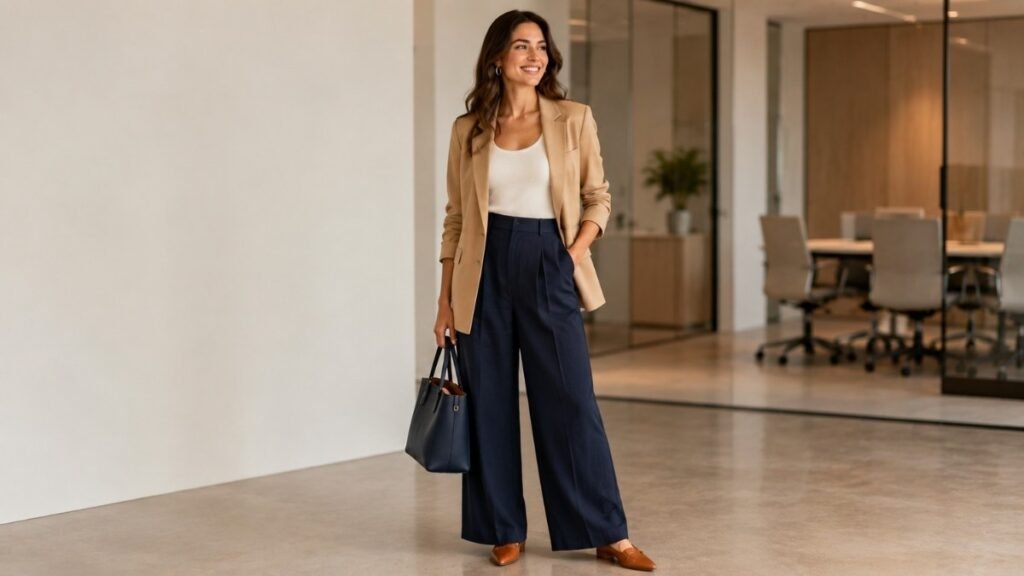
Best for: Meeting Days
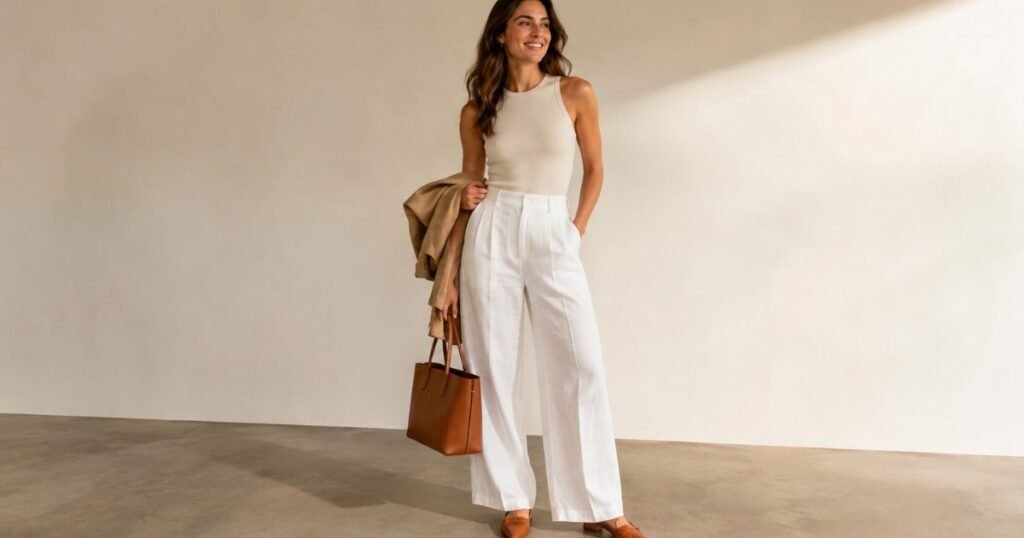
This is the summer version of the power outfit. The wide-leg trouser in a lightweight fabric (cotton poplin, linen-blend, rayon) handles the heat; the fitted tank keeps you cool underneath; the blazer goes in your bag during the commute and on your shoulders the moment you walk into the building.
Why it works during an actual workday: The tank-and-trouser combination is complete and professional on its own — if the meeting room is warm, the blazer can come off without the outfit losing its authority. The wide leg moves with you, doesn’t cling in the heat, and looks intentional in a way that shorts or casual trousers don’t.
The execution: High-waist wide-leg trousers in navy, white, or camel. A fitted tank in a solid neutral that matches or complements the trouser. A linen or unstructured blazer in a coordinating tone — carry it, don’t wear it until you’re inside.
Formula 2: Cotton Shirt + Midi Skirt
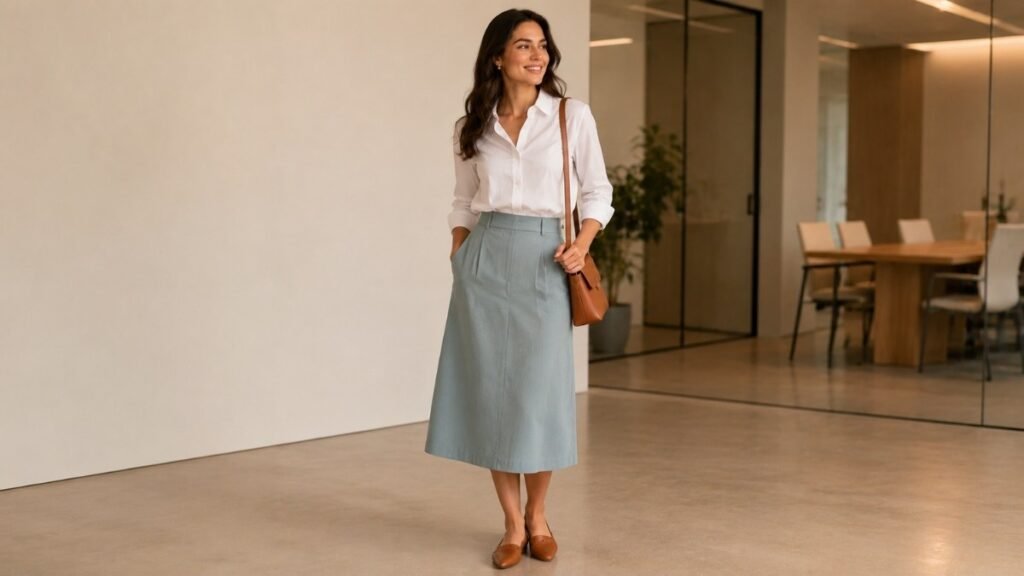
Best for: Business Casual Offices
The midi skirt is genuinely one of the most underrated summer work pieces. It covers the thighs (relevant for long days, commutes, and thigh-chafing), moves freely in heat, and reads as professional without requiring a blazer to make it work.
Why it works during an actual workday: A cotton poplin or linen button-down tucked into a midi skirt creates a complete, cohesive look that transitions from desk to meeting to a post-work dinner without changing. The button-down can be untucked and tied at the waist for a more casual moment; re-tucked for a more polished one.
The execution: A midi skirt in a solid color or subtle print — satin-finish fabrics look more elevated, cotton or linen look more casual. A fitted button-down or structured blouse tucked in. Loafers or block-heel sandals. A simple structured bag.
Formula 3: Sleeveless Dress + Cardigan
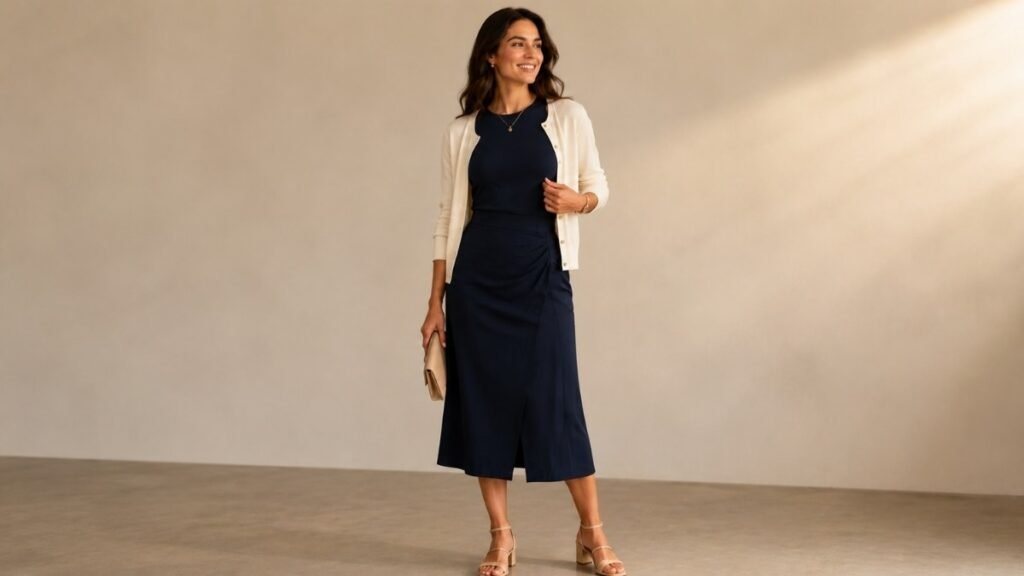
Best for: Office + After-Work Dinner
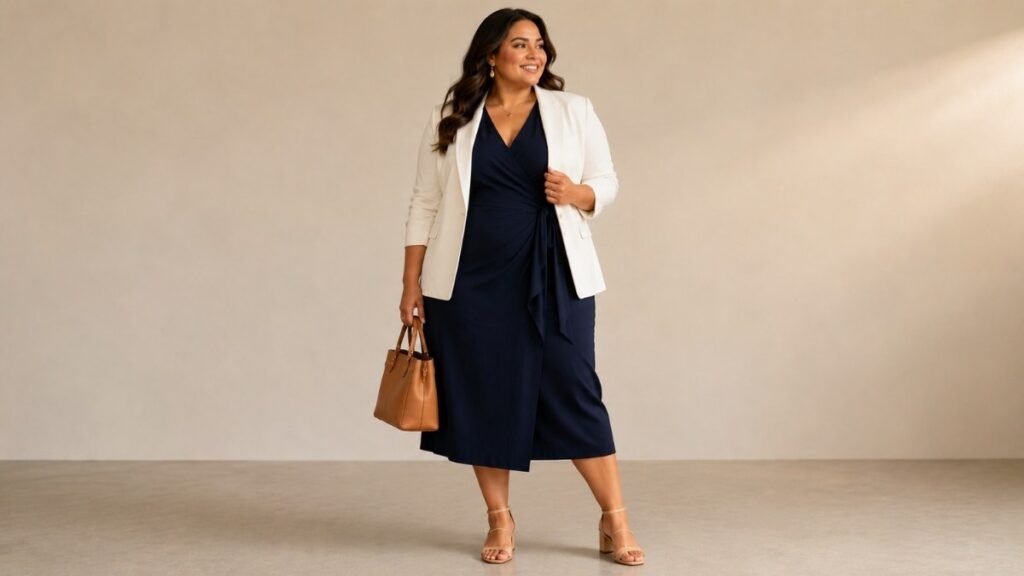
The sleeveless dress is the most efficient summer work piece because it’s a single item that handles the whole outfit. The cardigan handles the office AC. At dinner, the cardigan comes off and the dress carries the evening.
Why it works during an actual workday: You’re not coordinating separates in the morning heat. You get dressed in one piece, add the cardigan for the office environment, and the entire outfit is complete. A wrap dress or A-line sheath in a quality fabric handles every meeting from formal to casual.
The execution: A sleeveless midi dress in a structured fabric — crepe, ponte, or a quality jersey. Not a flimsy fabric that shows every imperfection of what’s underneath. A lightweight cardigan in a coordinating neutral — not a thick knit, a thin cotton or fine-gauge knit. Flat sandals or loafers for the commute; keep a pair of block heels at the office if the dress requires a slightly more elevated finish.
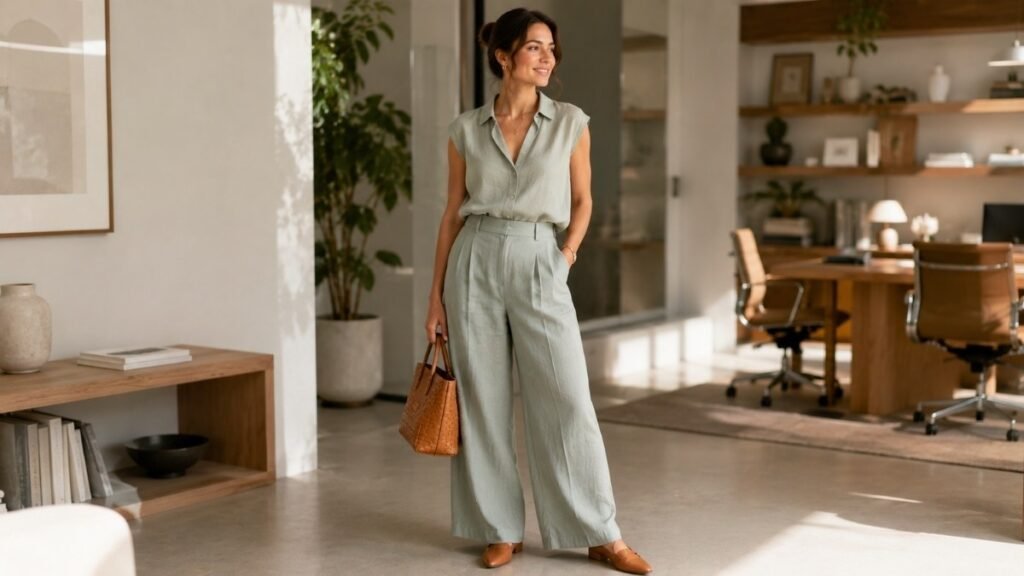
Formula 4: Matching Linen Set
Best for: Creative Offices
A matching linen set — wide-leg trousers and a blouse, or shorts and a shirt — reads as intentional and put-together because it is. The coordination is built in; no effort required.
Why it works during an actual workday: The matching set eliminates the morning decision fatigue that’s particularly acute in summer when nothing feels like it goes together correctly. It’s inherently cohesive. In a creative office, it reads as stylish and considered without crossing into business casual territory that feels out of place.
The execution: A linen set in cream, sage, dusty blue, or warm tan. The key is fit — a linen set that’s too oversized reads as pajamas; one that fits well reads as intentional. Add a structured bag and simple shoes to maintain the professional signal.
One Piece × Three Looks: The Linen Blazer Formula
This is the summer capsule principle: one versatile piece generating multiple distinct outfits across the week.
One Linen Blazer:
Monday — Meeting Day: Linen blazer + fitted tank + tailored trousers. The blazer provides structure for the meeting; the tank keeps you cool underneath. Loafers.
Wednesday — Office Day: Linen blazer worn open over a midi dress. The blazer is the third piece that makes the dress look office-appropriate. Block-heel sandals.
Friday — Happy Hour: Linen blazer + fitted top + dark-wash jeans (if your office allows). The blazer elevates the casual bottom. Add statement earrings and a nicer sandal to shift the register from work to social.
Three looks, one investment piece, minimum effort.
Business Casual vs. Smart Casual: What Actually Works in Summer
Business Professional
In conservative environments — finance, law, consulting — summer business professional means the same formality level as winter, just in lighter fabrics. A structured sheath dress in cotton crepe rather than wool. Tailored trousers in a linen blend rather than heavy gabardine. Closed-toe shoes remain the safer choice.
The fabric upgrade is everything at this level: the same silhouette in a summer-weight fabric reads as professional; in a casual fabric it reads as out of place.
Business Casual
The most common summer office setting. Here the formula has more flexibility: a sleeveless blouse with tailored trousers, a wrap midi dress, a linen co-ord, or the cotton shirt plus midi skirt combination from Formula 2. Blazers are optional and can be carried rather than worn.
Open-toe block-heel sandals are generally acceptable in business casual summer settings. Very strappy or embellished sandals push into evening territory; closed-toe flats or loafers are always safer if you’re uncertain.
Smart Casual
The most relaxed professional dress code. Dark-wash jeans with a structured blouse, a casual midi dress, linen trousers with a fitted tank — the “business” element is in the intentionality and fit, not in specific pieces. Clean sneakers become acceptable at the smart casual level in most offices.
When It’s Okay to Wear Sneakers or Sandals
Sneakers: In smart casual and tech/creative environments only. Clean leather sneakers (not athletic trainers) with a polished outfit. In conservative settings, not appropriate regardless of weather.
Sandals: Block-heel or low-heeled sandals with covered straps are appropriate in most business casual settings. Flat thong sandals or very strappy evening-style sandals generally aren’t. When in doubt: if the sandal looks like something you’d wear to a restaurant, it’s probably fine; if it looks like something you’d wear to the beach, it’s probably not.
Best Lightweight Fabrics to Keep You Cool Without Looking Wrinkled
Personally, I’d rather wear slightly wrinkled linen than spend an entire commute sweating inside polyester.
Linen
Pros: The most breathable natural fabric available. Genuinely keeps you cooler than anything else. Gets softer and more comfortable with washing.
Cons: Wrinkles. Not slightly — dramatically. By mid-morning, pure linen that looked crisp at 8 a.m. can look slept-in.
Wrinkle Reality: The question isn’t whether linen wrinkles — it does, always — it’s whether the specific piece wrinkles in a way that looks intentional or in a way that looks like you slept on a train. Linen trousers wrinkle less obviously than linen shirts. A linen blazer develops structured wrinkles that read as texture. A linen blouse can look dramatically crumpled by noon.
The solution: Linen-blend fabrics (linen + cotton, linen + rayon, linen + a small amount of stretch) wrinkle significantly less than pure linen while retaining most of the breathability. For high-stakes days — important meetings, presentations — choose a linen blend or a different fabric entirely.
How to reduce linen wrinkles during a workday: Hang your linen pieces overnight rather than folding them. Bring a small travel-size wrinkle spray to the office. If you sit for long periods, stand up and give the fabric a shake periodically. The texture of linen means slight wrinkling reads as intentional; it’s only the dramatic crush-wrinkling that looks unprofessional.
Cotton Poplin
The most underrated summer work fabric. Cotton poplin is crisp, breathable, comes in a wide range of colors, and resists wrinkles significantly better than linen. A cotton poplin button-down shirt is arguably more practical than a linen shirt for summer office wear because it looks crisper longer and handles the sweat-and-air-conditioning cycle better.
The downside: Less breathable than linen in extreme heat. White cotton poplin shows sweat. In very hot outdoor conditions, it can feel damp.
Rayon and Viscose
Rayon is the secret weapon of summer dressing. It drapes beautifully, resists wrinkles, breathes reasonably well, and photographs as if it cost significantly more than it did. Most flowing summer dresses are rayon for exactly this reason.
The downside: It doesn’t perform well when very wet — if you sweat heavily in rayon, the fabric can become clingy and slightly transparent. Darker colors hide this better than light ones.
Crepe
Structured crepe — particularly stretch crepe or polyester-crepe blends — is the summer fabric that looks the most professional the longest. It doesn’t wrinkle, doesn’t cling, and holds its shape from morning to evening. The trade-off is breathability: crepe is less breathable than natural fabrics.
For air-conditioned offices where heat is less of an issue than professional appearance, crepe is one of the best summer work fabric choices.
Performance Fabrics
Fabrics marketed as moisture-wicking, wrinkle-resistant, or temperature-regulating have improved significantly. For commuters who walk or use public transit in serious heat, a performance fabric blouse or dress that wicks sweat and resists wrinkles may be genuinely more practical than a beautiful linen piece that arrives crumpled and damp.
The aesthetic limitation: performance fabrics rarely look as polished as natural ones. They’re a practical choice, not a style choice. Use them for the commute; consider changing or carrying the more polished piece separately.
Summer Office Dressing Tips for Petite, Pear-Shaped, and Curvy Women
Petite
The summer work challenge for petite women is length. A midi dress that hits elegantly below the knee on a taller frame hits at an unflattering mid-calf on a shorter one. A wide-leg trouser that creates a beautiful elongated line in the right length drags on the floor without it.
The height strategy: High-waist everything. The high waistband creates visual leg length from the waist up. Pointed-toe shoes extend the visual leg line beyond the toe — in summer, a pointed-toe flat or low-heeled pointed mule does more for proportions than a round-toe sandal. Monochromatic color combinations (white trousers + white top, navy dress + navy shoes) create an unbroken vertical line that reads as height. For dresses: knee-length or just above rather than true midi.
Pear Shape
Summer work dressing for pear shapes follows the same upper-emphasis principle as everyday dressing, with some summer-specific adjustments. The sleeveless-dress-and-cardigan formula is particularly effective: a wide neckline on the dress creates shoulder width; the cardigan adds visual bulk to the upper half when needed. Wide-leg trousers in a dark color + a bright or patterned top is the summer version of the pear-shape formula.
The summer-specific note: Avoid very tight, pale-colored midi skirts that fit closely through the hip and thigh — in summer fabrics, these can cling in ways that emphasize rather than balance. An A-line or slightly flared midi skirt moves freely and creates a more balanced silhouette.
Curvy Body
High-waist everything, wrap silhouettes, and fabrics with some structure or drape rather than fabric that clings. The specific summer challenge for curvy bodies is fabric behavior in heat: thin jersey that fits well in a cool fitting room can behave differently — clinging, becoming slightly transparent — in summer heat. Choose fabrics with enough weight to maintain their drape: a heavier rayon, a structured crepe, or a cotton-blend with enough body to hold its shape.
The wrap dress advantage: The wrap dress is the single most reliably flattering summer work piece for curvy bodies because it creates waist definition through construction rather than through fit. It adjusts to your body rather than requiring your body to adjust to it.
How to Hide Sweat Without Wearing Oversized Clothes
This is the question that appears constantly in real conversations about summer dressing, and most guides skip it entirely.
Fabric choices: Darker colors and patterns hide sweat better than light solids. Rayon and cotton blend absorb and conceal; very thin jersey shows immediately. A navy midi dress hides what a white cotton blouse cannot.
Undergarment strategy: A thin, moisture-wicking camisole or breathable bra liner between your skin and your outer layer creates a barrier that absorbs sweat before it reaches visible fabric. This works particularly well under blazers and structured blouses.
Cut strategy: Sleeveless styles where the underarm area isn’t covered by a sleeve eliminate the most common visible sweat location. If you prefer sleeves, a loose flutter or cap sleeve allows more air movement than a fitted sleeve that presses against the skin.
Summer Office Life Hacks: Beat Sweat, Wrinkles, and Freezing AC
This is the section most guides skip entirely. These are the practical things that actually make summer office dressing manageable.
How to Layer Without Feeling Bulky
The principle: your layer should be either thinner than what’s underneath or structured enough to replace the visual weight it adds. A fine-gauge knit cardigan over a sleeveless dress adds warmth without adding visual bulk. A linen blazer over a tank adds structure and coverage. A thick knit cardigan over a structured blouse is two warm layers that work against each other aesthetically.
The summer layering hierarchy: sleeveless base → thin cardigan or kimono → unstructured blazer. Each layer is thinner than the one beneath it.
Office Sweater Strategy
Keep a dedicated layer at the office. This solves the commute-to-office temperature problem without requiring you to carry it both ways every day. A thin cardigan or a lightweight blazer that lives on the back of your office chair handles the AC without requiring you to carry it in 90-degree heat. A slight wrinkle on a piece that lives at the office is significantly less annoying than the same wrinkle on a piece you’ve carried all day.
Commute Clothes vs. Office Clothes
The most practical approach for extreme summer heat: commute in a lighter version of the outfit, change or add the professional layer when you arrive. Specifically: commute in the dress or trousers without the blazer; add the blazer at the office. Or: wear a casual version of the outfit on the commute and keep a more professional blouse at the office to change into.
This requires either a locker, a desk, or a low-key relationship with the office bathroom — but for women with long summer commutes, it genuinely makes the experience more manageable.
How to Prevent Sweat Stains
The practical toolkit: Sweat-shield inserts or dress shields (small absorbent pads that attach to the inside of garment underarms) are worth knowing about and using. They’re not glamorous, but they solve the white-blouse-sweat problem more reliably than any fabric choice.
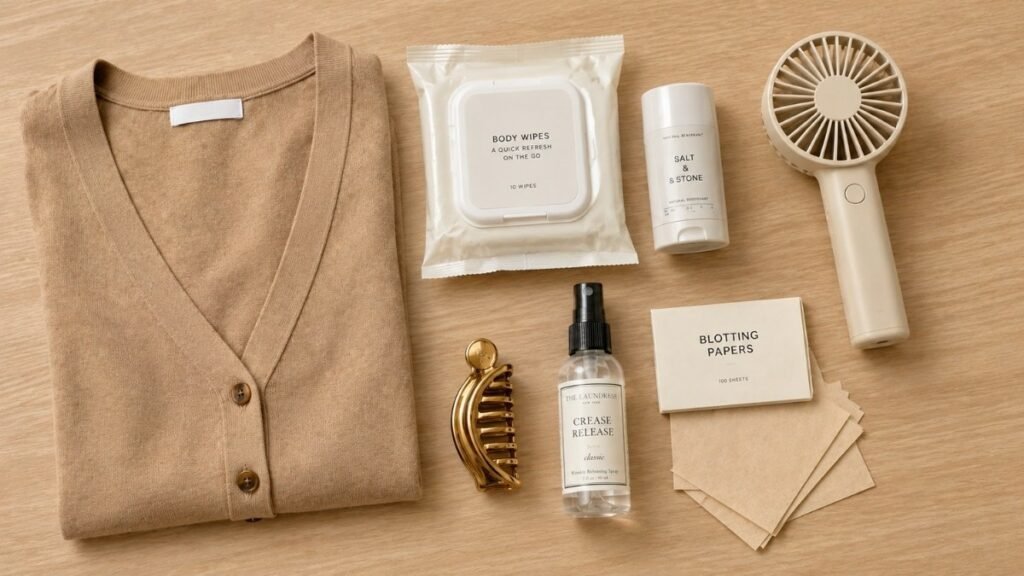
Breathable camisoles underneath blouses create an absorbing layer. Anti-perspirant applied the night before (not the morning of) performs significantly better. Body wipes or cooling wipes in your desk drawer handle mid-day freshness. A mini deodorant or solid fragrance in the desk for touch-ups.
How to Prevent Thigh Chafing Under Dresses
A genuine quality-of-life issue during summer dressing that nobody discusses in professional style content.
The solutions: Bike shorts or slip shorts worn under dresses — they extend to mid-thigh, prevent chafing, and also eliminate any transparency concern with lighter dresses. Anti-chafing sticks (sold as balm products or specifically as anti-chafing products) applied to inner thighs. Cotton shorts worn under dresses for longer commutes.
Bike shorts in particular have become a standard under-dress layer and work completely invisibly under midi dresses.
How to Keep Hair and Makeup Fresh During Your Commute
Hair: A clip or bun for the commute, let down when you arrive. A banana clip or jaw clip creates a polished held-back style that doesn’t crease the hair the way a tight ponytail does — meaning you can wear it down at the office without obvious marks. Dry shampoo at the roots before you leave absorbs commute sweat before it accumulates.
Makeup: A setting spray before leaving locks in makeup through a sweaty commute better than powder alone. Blotting papers at the desk for mid-day touch-ups. A portable fan — the small handheld ones — is legitimately useful and has no aesthetic downside.
Shoes That Actually Work for Long Summer Commutes
Loafers
Still the most versatile summer work shoe. Breathe reasonably well, look professional across all dress codes, and handle extended walking without the instability of a high heel. Leather loafers in tan or black are the most durable; leather-look options perform similarly in heat.
Mules
The open back makes mules significantly more breathable than closed-toe shoes — important for long summer days. A low-heeled or flat mule in a pointed toe reads as professional in most business casual settings. The tradeoff: mules require a slightly different walking gait and can feel unstable on longer commutes.
Clean White Sneakers
In smart casual and creative/tech offices only. The leather or leather-look version (Nike Air Force 1, New Balance 574, Adidas Stan Smith) crosses into business casual territory in a way canvas sneakers don’t. With wide-leg trousers and a structured blouse, they read as intentional. With a tailored suit or formal dress, they don’t.
Espadrilles
An underrated summer commute shoe. Comfortable, breathable, light, and they look more polished than sandals or sneakers in most office contexts. Flat espadrilles for commutes; a low wedge espadrille for days when you want a slightly more elevated finish.
Shoes to Avoid
- Very thin-soled flat sandals for long commutes on pavement — your feet will hurt by afternoon
- High stiletto heels for walking any significant distance — the heat makes everything worse and heels on hot pavement are genuinely uncomfortable
- Flip flops — even in the most casual office, they read as too casual and too beach-adjacent for professional settings
- New shoes not broken in — blisters are significantly worse in summer when feet are swollen from heat
Build a Budget-Friendly Summer Work Capsule Wardrobe
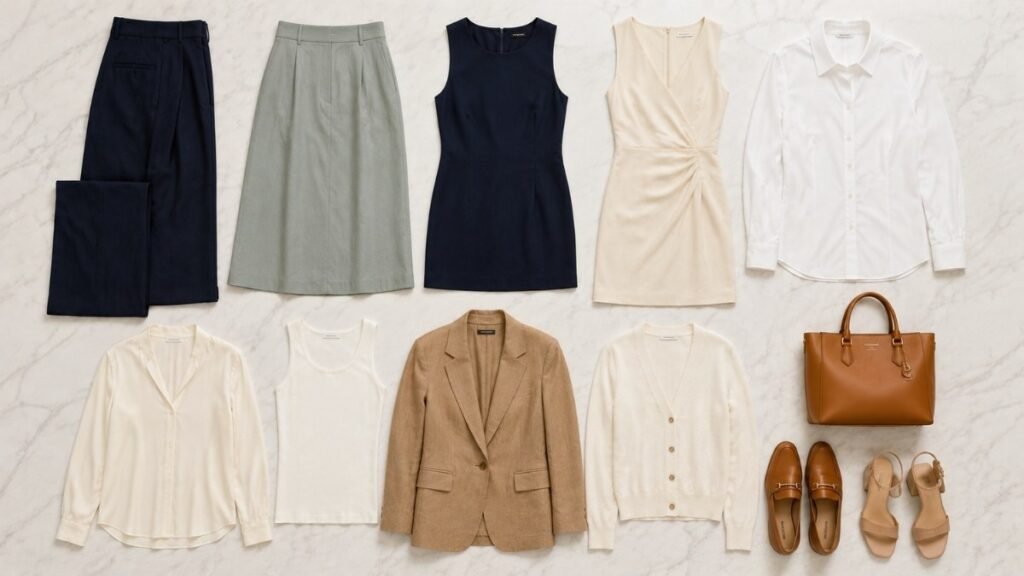
10 Versatile Pieces
1. Wide-leg trousers — navy or white (linen-blend)
2. Tailored midi skirt — solid neutral
3. Two sleeveless dresses — one casual, one elevated
4. Two blouses — one fitted button-down, one flowing
5. One fitted tank in white or neutral
6. One linen or unstructured blazer
7. One thin cardigan (for the office)
8. One pair flat sandals
9. One pair loafers or mules
10. One structured bag
Mix-and-Match Examples
From these 10 pieces:
- Trouser + blouse + blazer (carried) = Formula 1 meeting day
- Midi skirt + button-down = Formula 2 business casual
- Elevated dress + cardigan = Formula 3 office to dinner
- Casual dress + blazer = creative office polish
- Trouser + tank + loafers = Friday smart casual
That’s 10+ distinct looks from 10 pieces.
Where to Invest vs. Where to Save
Invest in: The blazer (worn constantly, lasts multiple seasons), the loafers (daily use, quality matters), the elevated dress (represents the whole outfit in meetings).
Save on: Basic tanks (Uniqlo, H&M), cardigans (any fast fashion brand makes acceptable thin cardigans), simple blouses in neutral colors.
The cost-per-wear principle: A $150 blazer worn 60 times this summer costs $2.50 per wear. A $40 trendy blouse worn 4 times costs $10 per wear. The math consistently favors investment in the pieces you wear most often.
Summer Work Wardrobe Mistakes You Should Avoid
Choosing Fabrics That Show Sweat
White cotton, thin jersey, and light-colored polyester all show sweat immediately and obviously. This isn’t a styling judgment — it’s a practical one. If you run warm or have a long commute, build your summer work wardrobe around fabrics and colors that conceal rather than reveal.
Wearing See-Through White Tops
White is a summer staple, but white fabric in summer behaves differently than white fabric in air-conditioned spring: it can become slightly transparent with sweat, it shows bra lines more obviously, and it requires specific undergarment choices. Hold white pieces up to light before buying them. If you can see your hand through the fabric, you’ll be able to see your bra through it in an office.
Ignoring Office AC
Dressing only for the outdoor temperature and arriving underprepared for the office environment is one of the most common summer work outfit mistakes. The 30-minute commute in 90-degree heat requires breathability; the 8 hours in the office requires a layer. Building both into every outfit from the start — rather than being caught without one or the other — is the most practical thing you can do.
Buying Trendy Pieces You Only Wear Once
Most women don’t regret buying expensive clothes. They regret buying clothes that only looked right in the fitting room. A trendy summer piece at a lower price point that you wear twice costs more per wear than a classic piece at full price that you wear 30 times. This is particularly true for summer work clothes: the occasions where you need to look professional don’t stop being occasions because they’re in July.
Choosing Beauty Over Comfort
The best summer work outfit isn’t the one that looks most impressive in a photo. It’s the one that keeps you confident and comfortable from 8 a.m. to 6 p.m. in conditions that include heat, air conditioning, walking, sitting, and meeting people. An outfit that requires constant management — adjusting, pulling, re-tucking — consumes mental energy and shows.
Final Thoughts: Dress for Real Life, Not Just Instagram
Summer workwear doesn’t have to be complicated. The best outfits aren’t the trendiest or the most expensive—they’re the ones that keep you comfortable on your commute, polished in the office, and confident throughout the day.
Start with versatile basics, choose breathable fabrics, and build a wardrobe that works with your routine instead of against it. A few well-chosen pieces can create dozens of reliable outfits without filling your closet with clothes you rarely wear.
After all, great workwear isn’t about impressing everyone else. It’s about helping you feel prepared, professional, and comfortable every time you walk into the office.
FAQ: Summer Work Outfits
How can I stay cool during my summer commute without looking unprofessional at work? Carry your professional layer (blazer, structured blouse) rather than wearing it during the commute. Commute in the dress or trousers alone; add the layer when you arrive. Choose breathable fabrics — linen blend, cotton poplin, rayon — for the commute portion, and keep a more structured piece at the office if needed.
What’s the best fabric for summer office clothes that won’t wrinkle easily? Cotton poplin and stretch crepe wrinkle significantly less than pure linen while remaining appropriate for professional settings. Rayon drapes beautifully and resists wrinkling. Pure linen is the most breathable but wrinkles dramatically — opt for linen-blend fabrics for professional settings where wrinkle-resistance matters.
Can I wear sneakers or sandals to work in the summer? Clean leather sneakers are appropriate in smart casual and tech/creative offices. Block-heel or low-heeled sandals with modest straps work in most business casual environments. Very casual sandals (thong sandals, flip flops) and athletic trainers aren’t appropriate in professional settings regardless of the weather.
How do I dress professionally if I sweat a lot? Choose darker colors and patterns that conceal rather than reveal. Use a breathable moisture-wicking camisole as a barrier layer under blouses. Apply antiperspirant the night before, not the morning of. Keep deodorant wipes, a mini deodorant, and blotting papers at your desk. Consider sweat-shield dress shields for important days.
What should petite women wear to look taller in summer work outfits? High-waist bottoms always — the waistband creates visual leg length. Pointed-toe flats or low heels extend the visual leg line. Monochromatic color combinations create an unbroken vertical line that reads as height. Choose knee-length or just-below-knee dresses rather than true midi lengths that can hit awkwardly on shorter frames.
How do I stop thigh chafing when wearing skirts to work? Bike shorts or slip shorts worn under dresses and skirts are the most effective solution. They extend to mid-thigh, prevent chafing, and are completely invisible under midi-length skirts. Anti-chafing balm sticks applied to inner thighs also work for less extreme chafing.
How can I handle freezing office air conditioning in summer? Keep a dedicated layer at the office — a thin cardigan or lightweight blazer that stays on the back of your chair. This solves the problem without requiring you to carry a layer through the heat. Desk-drawer additions: a pair of warm socks if your feet get cold, a lap blanket if your office is particularly aggressive with AC.
How many pieces do I really need for a summer work capsule wardrobe? Ten pieces cover most women’s summer work needs for a full season: two bottoms (trouser and skirt), two dresses, two blouses, one tank, one blazer, one cardigan, and one structured bag. Two shoe options (flat sandal + loafer) handle most dress codes. This generates enough combinations for a full five-day work week without repetition.
TopChicWear Style Notes
The best summer work outfits do more than look professional—they help you stay comfortable throughout the day.
This guide combines workplace research with practical styling advice, covering professional dress, breathable fabrics, thermal comfort, and everyday office challenges like commuting, air conditioning, and long workdays.
Our goal is simple: help you build outfits that are polished, comfortable, and realistic for everyday life.
What to Read Next
- Work Outfits for Women: What Is Business Casual — the year-round work outfit guide with industry-specific formulas
- What Is Business Casual for Women? — the definitive guide to decoding office dress codes
- Linen Pants for Women: How to Style Them — linen trousers are a summer work staple; this guide covers every styling angle
- How to Dress Better: Fashion Tips to Look More Put Together — the broader styling principles that apply to work dressing year-round
TopChicWear creates practical style guides designed to make everyday dressing simpler, smarter, and more enjoyable.