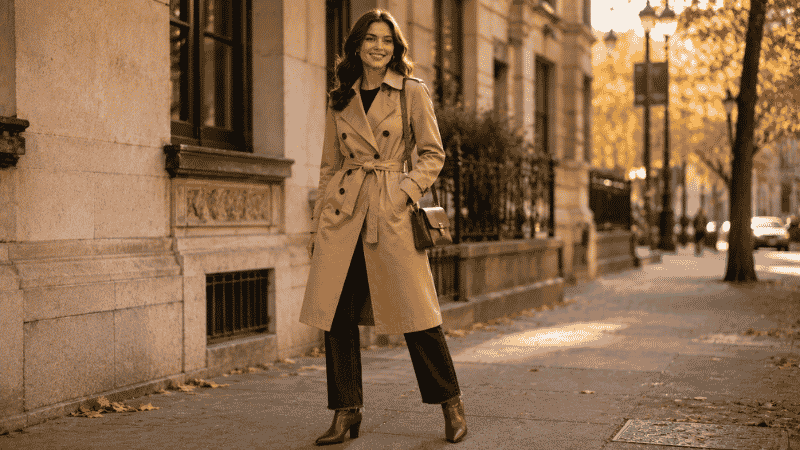
A trench coat should be the easiest thing to wear. It’s a classic. It’s been in continuous fashion production for over a century. Every style guide ever written says it’s “versatile” and “timeless.” And yet you put yours on, look in the mirror, and something’s just slightly off. Maybe it feels stiff. Maybe it looks shapeless despite having a belt. Maybe the whole thing just reads as “I grabbed a coat to leave the house” rather than the effortless chic you were aiming for.
Here’s the thing: how to style a trench coat isn’t complicated, but it does require understanding a few specific things that generic style guides skip entirely. What you do with the belt changes the entire silhouette — and there’s more than one way to handle it. The thickness of your inner layers affects how the coat falls. The color of your trench coat dictates which inner combinations work and which ones fight with it. And for petite women specifically, the length of the coat is doing a lot of work that nobody explains.
This guide covers all of it. By the end, you’ll understand why your trench coat hasn’t been looking the way you wanted it to — and exactly what to do differently.
Key Takeaways
- The belt is not just for warmth — it’s the single most powerful styling tool on a trench coat, and how you tie it determines whether the coat looks polished and intentional or shapeless and thrown-on
- A trench coat is designed to be worn over a medium-weight layer (a light sweater, a blazer, a fine-knit) — wearing it over a very thick layer distorts the shoulders and back and defeats the silhouette entirely
- According to a 2023 Euromonitor International report, the classic trench coat has remained a top-10 outerwear purchase globally for three consecutive years, with the camel and beige colorways consistently outselling all other options
- Camel, beige, and black trench coats require different inner color strategies — we’ll break these down specifically
- For petite women: a cropped or mid-length trench coat (ending at or just below the hip) creates significantly better proportions than a full-length version that cuts the silhouette at mid-calf
- The most common trench coat mistake: wearing it completely open with no belt and no structure. An open trench coat without any deliberate styling reads as “I’m using this as a blanket” rather than a considered outer layer
The Belt: The Most Important Trench Coat Styling Decision
Everything else — the outfit underneath, the shoes, the accessories — comes second to the belt. The belt is what turns a trench coat from a shapeless fabric tube into a structured, flattering garment. Getting it right changes the entire look.
Belt Tie Method 1: The Classic Front Knot
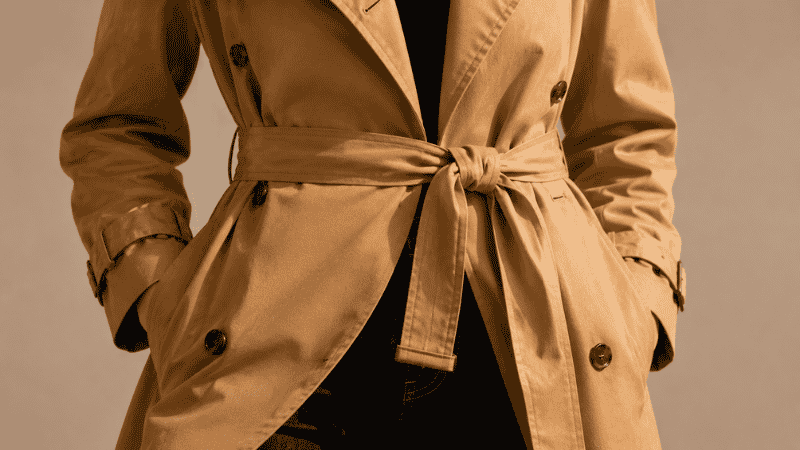
This is the most common and most polished version. Thread the belt through the buckle (most trench coats have a D-ring or a half-buckle at the front), then tie the excess in a simple knot or a loose bow at the front. The knot sits at the natural waist, creating a defined waistline.
When to use it: Professional settings, smart casual occasions, any time you want the trench to read as intentional and put-together. The front knot signals that you thought about how this coat looks, which reads as confidence.
The key detail: The knot shouldn’t be tight and fussy — a slightly loose, slightly asymmetrical knot looks more effortless than a perfectly centered bow. Think “I tied this while walking out the door” rather than “I spent five minutes at the mirror.”
Belt Tie Method 2: The Back Knot (For a Relaxed Look)
Take the belt all the way to the back, cross the ends, and tie a simple knot at the back. From the front, the coat drapes open (or slightly gathered at the waist) without a visible belt buckle or knot.
When to use it: Very casual settings, weekends, when you want the trench to feel more relaxed and less formal. The back knot creates a softer silhouette than the front knot — slightly more draped, slightly less structured.
The petite caveat: The back-knotted trench coat can shorten the visual silhouette on a petite frame because the gathered fabric at the back adds volume without adding length. Front-knotting is generally more proportional for women under 5’4″.
Belt Tie Method 3: Leaving It Unbuttoned But Belted
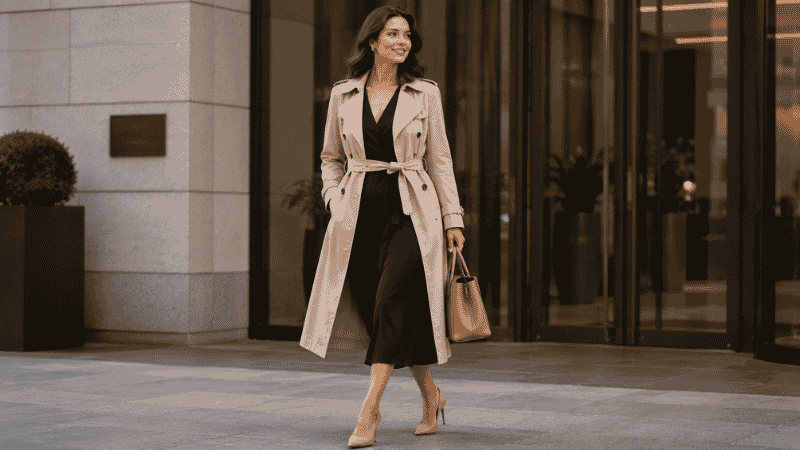
Button none (or only the top button) of the coat, but still use the belt at the waist. This creates a V-shape opening in the front that shows your inner outfit while the belt maintains the waist definition.
When to use it: When you want to show off what’s underneath — a particularly nice blouse, an interesting dress, a work outfit you’re proud of. The open front + belted waist reads as deliberately layered rather than half-dressed.
What to wear underneath: This method specifically calls for a complete inner outfit that looks good on its own. A well-fitting dress or a polished blouse-and-trouser combination. Not a casual tee and jeans — the open-front belted trench is a showcase method, so the showcase needs to be worth it.
Belt Tie Method 4: Completely Open and Unbelted (The Only Time This Works)
An open, unbelted trench coat reads as intentionally relaxed only in one specific context: when the coat is very oversized and worn as a deliberate outermost layer over a complete, polished outfit. Think: fashion week street style, where an enormous trench coat floats over a head-to-toe look underneath.
For most real-world situations, an open unbelted trench coat reads as “I forgot to get dressed properly and threw this on as coverage.” Unless you’re going for the very specific oversized-as-statement look, use the belt.
What to Wear Under a Trench Coat: The Layer Thickness Problem
The trench coat was designed with a specific inner layer thickness in mind — typically a light to medium-weight layer. Most classic trench coats are cut to fit over a fine-knit sweater, a blazer, or a button-down shirt. This is the “intended” configuration, and it’s why the shoulders sit correctly and the back falls smoothly.
When you put a trench coat over something too thick — a heavy puffer vest, a chunky knit, a thick hoodie — the shoulders distort, the back bunches, and the structured silhouette that makes a trench coat look elegant collapses. You end up looking like you stuffed yourself into the wrong size.
The inner layer rule: If the trench coat shoulders are pulling forward or the back is creating fabric rolls, your inner layer is too thick. Either remove a layer, switch to a thinner alternative, or accept that this trench coat and this inner layer don’t work together.
What works well underneath:
A fitted turtleneck or fine-knit crewneck is the ideal winter inner layer — it adds warmth without bulk and leaves the coat’s shoulder seams exactly where they’re supposed to be. A silk or woven button-down is the ideal spring/fall inner — light, polished, and doesn’t add any meaningful thickness. A tailored blazer works as a mid-layer if the trench coat was bought with room for it — but if the coat is fitted through the shoulders, a blazer underneath will fight for space.
The blazer-under-trench question: This is possible but requires the right size trench coat. If your trench coat fits well over just a blouse, it will be too tight over a blazer. A trench coat that works over a blazer needs to be bought one size up from your usual coat size, or specifically designed for layering. If you regularly want to wear blazer + trench, size accordingly.
How to Style a Trench Coat by Color

Camel Trench Coat Outfits
Camel is the most popular trench coat color — and for good reason. The warm, rich tone works across most skin tones and complements almost every neutral wardrobe. But camel is also the trickiest to pair, because it’s warm-toned and specific in a way that cool-toned camel alternatives aren’t.
What works best under a camel trench coat:
- White and cream — the contrast is classic and clean
- Navy and cobalt — the cool tones balance camel’s warmth beautifully
- Burgundy and deep rust — warm-on-warm combinations that feel seasonal and intentional
- Black — creates high contrast that lets the camel coat be the clear statement
What creates a muddy combination: Yellow-toned beige or tan in a similar warmth to the camel coat — the two warm neutrals compete rather than complement. Very light grey — it can look slightly washed-out against warm camel.
The camel coat outfit formula: Dark-wash jeans or black trousers + a white or cream fitted top (tucked) + the camel trench coat + pointed-toe loafers or ankle boots. This combination is reliable, polished, and works from September through March.
Beige Trench Coat Outfits
Beige is lighter and cooler than camel, making it the most versatile trench coat color — it genuinely goes with almost everything. The trade-off: it’s also the easiest to make look bland or washed-out if you’re not adding contrast somewhere.
What works best under a beige trench coat:
- Black — the cleanest, most high-contrast combination
- Navy — classic and reliably polished
- Rich jewel tones — forest green, burgundy, cobalt under a beige coat looks genuinely elegant
- Bold prints — a beige coat grounds a printed outfit beautifully
The beige coat danger zone: Very pale or very muted colors in the same neutral family as the coat — pale pink, pale grey, off-white. These can create a washed-out, monochromatic effect that lacks visual interest. If you want to do a tonal neutral outfit under a beige coat, go all the way and make it deliberately monochromatic.
Black Trench Coat Outfits
A black trench coat is the most versatile in terms of what you can wear underneath — almost anything works — but it requires more consideration for what’s visible at the collar and cuffs.
What works best under a black trench coat:
- White and cream — the classic combination that always reads as intentional
- Bright colors — cobalt, red, emerald peeking out from under a black trench coat looks sharp
- All-black underneath — full monochrome that looks dramatically chic rather than dull
- Patterns — a subtle plaid or stripe visible at the collar adds interest without competing
The black coat specific consideration: What shows at the collar matters more with a black coat than with a lighter one. If your inner layer creates a contrast at the collar (a white turtleneck, a patterned scarf), that detail becomes a focal point. Make it deliberate.
Trench Coat Outfit Ideas by Scenario
Casual Everyday Trench Coat Outfit
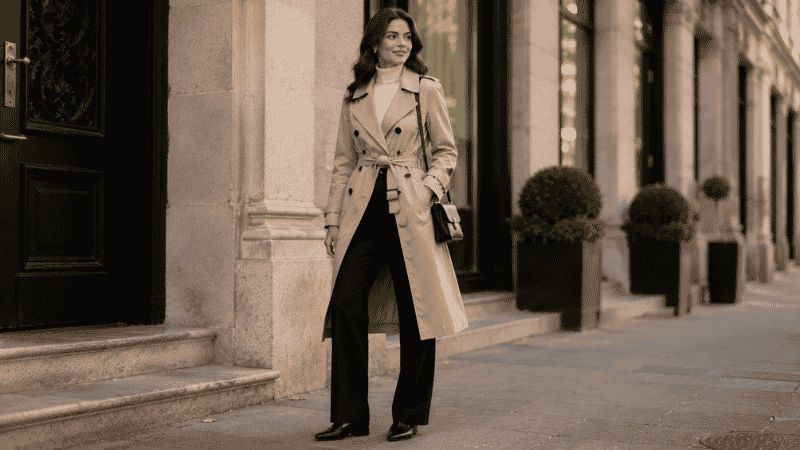
The everyday trench coat outfit is the combination that should be your default — easy enough to replicate daily, polished enough to look intentional anywhere.
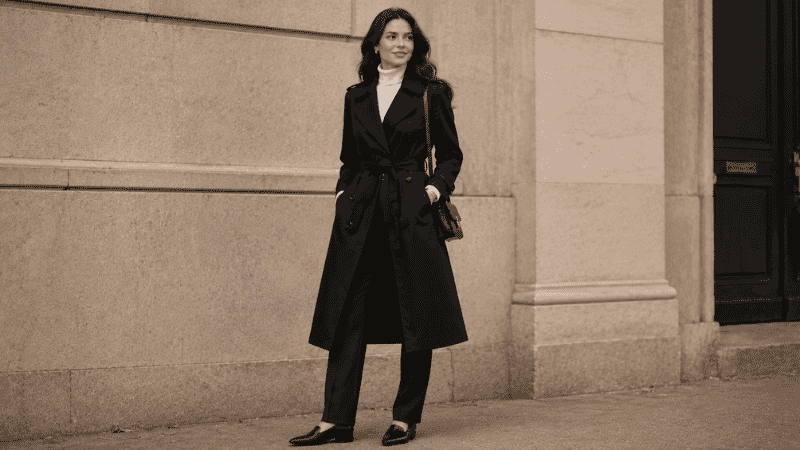
The formula: Dark-wash jeans or straight-leg trousers + a fitted top (turtleneck, crewneck, or blouse) + the trench coat belted at the waist with a front knot + ankle boots or loafers.
This works for commuting, weekend errands, coffee dates, casual work settings, and most scenarios where you need to look put-together without looking formal. The trench coat does most of the work — it elevates jeans-and-a-top into a complete outfit automatically.
Work Trench Coat Outfit
For office settings, the trench coat becomes outerwear that complements your work outfit rather than defining it. The key is that your work outfit needs to be complete and polished without the coat — the coat is just the finishing layer for the commute.
The formula: Tailored trousers or a midi dress + a fitted blouse or fine-knit sweater + the trench coat belted + pointed-toe flats or heeled loafers.
The specific office detail: In professional settings, button the coat closed for the commute and keep it belted even when it’s open in the office (if you’re wearing it at your desk). A completely open, floppy trench coat in an office setting reads as casual in a way that undermines the professional energy you’re trying to create.
Date Night Trench Coat Outfit
The date night trench coat is where the open-front-belted method works particularly well — showing off a polished dress or elevated separates underneath while keeping the coat as a sophisticated outer layer.
The formula: A midi dress in a jewel tone or a polished blouse-and-trouser combination + the trench coat open but belted at the waist + heeled sandals or pointed-toe boots.
When you arrive at the restaurant, remove the coat and hang it. What’s underneath should be the complete evening look. The coat is your entrance and exit piece — let it do that job, then let the outfit underneath take over.
Trench Coat Styling by Body Type
For Petite Women: Length Is Everything
The single most important trench coat decision for petite women is length. A mid-thigh or hip-length trench coat is almost always more proportional than a full-length version that hits at mid-calf or below.
Why length matters so much: A coat that ends at mid-calf on a 5’10” frame ends well below the knee on a 5’2″ frame, cutting the silhouette at a proportion that shortens the visual leg significantly. The effect is that the coat overwhelms the frame rather than completing it.
What to look for: Cropped trench coats (ending at the hip or slightly below) or mid-length versions (hitting at mid-thigh) are the most proportional on petite frames. Some brands specifically make “petite” trench coats in shorter lengths — ASOS Petite and Gap Petite have reliable options.
The belt consideration for petite: Use the front-knot belt method rather than the back knot. The front knot keeps the waistline visible and creates a clear proportion between the upper and lower coat — which is what makes the coat look intentional rather than oversized on a shorter frame.
For Curvy Women: Fit at the Shoulders Matters Most
For curvy women, the most common trench coat fit issue is that standard sizing fits the shoulders but either pulls across the bust or has excess fabric at the waist that the belt can’t adequately manage.
The fit priority: Fit the shoulders first — a trench coat that fits the shoulders but is slightly large in the body can be managed with the belt. A trench coat that strains at the shoulders cannot be belted into looking good. If you’re between sizes, go up.
The belt approach for curvy bodies: The front-knot method works best — it creates a defined waist without requiring the coat to be tight. Tie the knot slightly to one side for a relaxed asymmetry that looks deliberately casual rather than trying too hard.
Length consideration: A mid-thigh to knee-length trench coat in a classic cut is the most flattering for most curvy bodies. Very long trench coats (below the knee) can add undifferentiated volume. Cropped versions (ending at the hip) can emphasize the hip point. The sweet spot is between them.
The Trench Coat Mistakes People Make Most Often
Wearing it completely open without the belt. Unless you’re specifically going for the oversized-coat-as-statement look, this reads as “I didn’t get dressed.” The belt is what makes a trench coat look intentional. Use it.
Wearing a coat that’s too small in the shoulders. This is the most common fit issue and the hardest to style your way out of. A trench coat that’s pulling across the back or at the shoulder seams will never look polished regardless of what you do with the belt. Size up if needed.
Over-layering underneath. The coat was designed for a specific layer thickness. Pushing it past that threshold distorts the silhouette in ways that can’t be recovered by belting tighter.
Choosing the wrong length for your height. This applies most strongly to petite women but affects all heights — a coat that ends at an unflattering proportion point (mid-calf on a petite frame, above the knee on a tall frame) disrupts the overall silhouette regardless of what’s underneath.
Treating it as a replacement for a real winter coat. A classic cotton or cotton-blend trench coat is a transitional weather piece — excellent for spring and fall, adequate for mild winter days, not warm enough for genuinely cold weather. If you need serious warmth, layer appropriately underneath or add a warmer coat to your rotation.
The 10-Minute Trench Coat Outfit
It’s raining, you have somewhere to be, you have ten minutes:
Step 1: Dark jeans or your best-fitting trousers. Step 2: A fitted top — white crewneck, black turtleneck, or simple blouse. Step 3: Ankle boots or loafers (comfortable, weather-appropriate). Step 4: Trench coat on. Belt tied with a front knot at the natural waist — not too tight, slightly to one side. Step 5: Gold hoops. Small bag.
Done. This outfit works for virtually any daytime setting. The trench coat does the heavy lifting — it makes jeans and a top look like a complete outfit without any additional effort.
FAQ: How to Style a Trench Coat
How do you tie the belt on a trench coat? The most common method is a simple front knot at the natural waist — thread the belt through the D-ring or half-buckle, then tie the excess in a loose knot slightly to one side. For a more relaxed look, take the belt to the back and tie it there, letting the coat drape open at the front. Avoid a tight, fussy bow — a slightly loose, slightly asymmetrical knot always looks more effortless.
What do you wear under a trench coat? A fine-knit sweater, a fitted turtleneck, a woven blouse, or a tailored blazer are the most appropriate inner layers. The coat is designed for medium-weight layers — too thick and the shoulders distort and the back bunches. For spring and fall, a blouse or thin knit is ideal. For winter, a fine-gauge sweater under the coat rather than a chunky knit.
Can petite women wear trench coats? Yes — look for cropped or mid-length versions that end at the hip or mid-thigh rather than full-length coats that hit below the knee. Use the front-knot belt method to maintain visible waist proportion. A coat that ends at the right length creates a polished, proportional look on a petite frame.
What color trench coat is most versatile? Beige is technically the most versatile because it’s neutral enough to work with almost any inner color. Camel is the most flattering across most skin tones but requires more careful inner color coordination. Black is the easiest in terms of what you can wear underneath but requires more attention to what’s visible at the collar.
Should a trench coat be worn open or closed? Either — but not unbelted. A closed, buttoned trench coat with a belted waist looks polished and traditional. An open trench coat with the belt creating waist definition (open-front-belted method) looks modern and shows off the inner outfit. Completely open and unbelted only works as a deliberate fashion statement with an oversized coat and a complete polished look underneath.
What to Read Next
- What to Wear With Wide Leg Pants: Tops, Shoes & Body Type Tips — the trench coat works as the outer layer in many wide-leg pants outfits; this guide covers the inner outfit
- Fall Outfits for Women: The Complete Style Guide — the trench coat is one of fall’s hero pieces; the full fall guide covers how it fits into a complete seasonal wardrobe
- How to Dress for Your Body Type: The Complete Style Guide — the petite and curvy trench coat considerations in this article connect to the full body type guide
Sophie Hartwell covers practical style advice for women who want their clothes to actually work at TopChicWear.
References:
- Euromonitor International. (2023). Global Outerwear Market Report: Classic Trench Coat Trends. Euromonitor International Ltd.
- Howlett, N., Pine, K., Orakçıoğlu, İ., & Fletcher, B. (2013). The influence of clothing on first impressions. Journal of Fashion Marketing and Management, 17(1), 38–48.
- Slepian, M. L., Ferber, S. N., Gold, J. M., & Rutchick, A. M. (2015). The cognitive consequences of formal clothing. Social Psychological and Personality Science, 6(6), 661–668.